

Ethical Jewelry Alternatives to Soko Market in 2026
Table of Contents
- Why Seek Soko Market Alternatives for Ethical Jewelry
- Top Ethical Jewelry Brands Empowering Artisans
- Sustainable Jewelry Marketplaces for Conscious Consumers
- Fair Trade Jewelry Online: Certifications & Transparency
- Ethical Jewelry Brands: Feature Comparison & Pricing
- How to Identify Truly Ethical Jewelry vs. Greenwashing
- Real Customer Reviews & Testimonials Across Alternatives
- Which Soko Market Alternative Is Right for You
Ethical Jewelry Alternatives to Soko Market in 2026
Last Updated: July 20, 2026
When shopping for jewelry with a conscience, consumers recognize that not all ethical brands operate the same way. A growing movement toward transparent supply chains and artisan empowerment has created a diverse marketplace of ethical jewelry options. Each purchase either perpetuates extractive practices or genuinely supports the communities making your pieces.
This guide explores ethical jewelry alternatives to Soko Market, comparing direct-to-consumer brands, curated marketplaces, and certified fair trade platforms, breaking down what makes each distinct and which alternative matches your values.
Why Seek Soko Market Alternatives for Ethical Jewelry
The ethical jewelry space has expanded dramatically from niche to legitimate category with dozens of credible players, each bringing different strengths. Some specialize in lab-grown diamonds, others in recycled metals, and some prioritize direct artisan relationships and cultural preservation alongside fair wages.
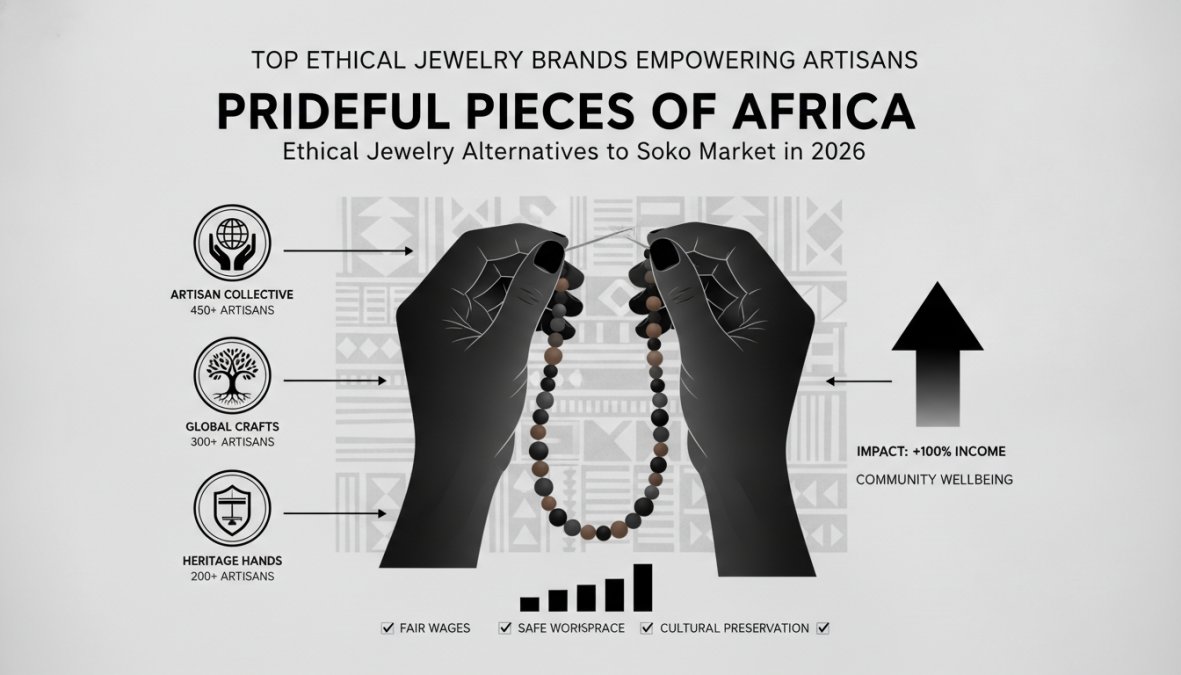
Understanding why you'd seek an alternative matters. Perhaps you want transparency to see exactly where your money goes, prefer specific materials like recycled gold or conflict-free diamonds, or value particular impact models: supporting women-led businesses, funding education, or preserving traditional craft techniques.
The ethical jewelry landscape includes independent artisan platforms, established e-commerce giants, and specialized marketplaces. Each model has trade-offs: marketplaces offer selection and discovery, direct-to-consumer brands offer transparency and story, and certification bodies offer verification.
Top Ethical Jewelry Brands Helping Artisans
Prideful Pieces of Africa: Handcrafted East African Excellence
Prideful Pieces of Africa operates on a fundamentally different model than marketplace aggregators. Every piece is handcrafted by skilled artisans across East Africa, no machines, no mass production, no two pieces identical. This is a curated brand with direct relationships to specific artisan communities, not a platform connecting buyers to thousands of sellers.
What sets Prideful Pieces of Africa apart is the direct impact model. When you purchase a piece, your money supports a family in Kenya, contributes to a child's school day, and provides clean water access. Each handcrafted piece preserves generations of tradition and cultural identity that would otherwise be lost to industrialization.
Customers consistently report feeling the authenticity. One customer from Cape Town said, "I've never owned anything that carries this much meaning. It's become an heirloom for my daughter." Another from Lagos noted, "More than jewelry, a wearable piece of culture. I feel the love in every bead."
For consumers prioritizing cultural preservation and direct artisan support, Prideful Pieces of Africa represents the highest standard of transparency and impact. The trade-off is specificity, you're choosing from a curated collection rather than browsing thousands of options.
Other Artisan-Focused Alternatives
Beyond Prideful Pieces of Africa, several brands emphasize direct artisan relationships and handmade production. The key differentiator: Does the brand know its makers personally, or does it aggregate from many sources? Direct relationships enable the kind of impact transparency Prideful Pieces of Africa provides. Larger networks offer more selection but dilute traceability.
Sustainable Jewelry Marketplaces for Conscious Consumers
Platform-Based vs. Direct-to-Consumer Models
The marketplace model, where a platform connects multiple sellers to buyers, dominates the ethical jewelry space. Etsy, Amazon Handmade, and specialized platforms like Not on the High Street all operate this way. The advantage is selection; the disadvantage is inconsistency in standards and transparency.
When you buy from a marketplace, you're trusting individual seller practices rather than a brand's unified standards. Some sellers provide detailed sourcing information; others offer minimal transparency.
Etsy remains the largest handmade marketplace with over 88 million active buyers. The community focus on handmade goods attracts conscious consumers, but quality varies widely and you're responsible for vetting individual sellers.
Amazon Handmade offers a curated alternative with Amazon's trust backing. The Handmade designation signals stricter handmade policies, though the emphasis remains on Amazon's brand rather than the maker's.
Shopify and BigCommerce enable brands to build their own stores. If you find an ethical jewelry brand you love, they likely use one of these platforms, giving you direct relationships with the brand rather than marketplace intermediation.
Fair Trade Jewelry Online: Certifications & Transparency
Understanding Certifications: Fairtrade, Fairmined & Beyond
The term "ethical jewelry" means nothing without verification. Certifications exist to prevent greenwashing.
Fairtrade Certification focuses on labor practices, community development, and environmental standards. It guarantees minimum prices for artisans, democratic decision-making in producer organizations, and investment in community projects through third-party audits.
Fairmined Certification specifically targets precious metals mining, ensuring miners receive fair prices, work in safe conditions, and have access to education and healthcare.
Kimberley Process Certification addresses conflict diamonds mined in war zones. While it has faced criticism for loopholes, it remains the baseline standard. Many ethical brands go beyond it, requiring lab-grown or recycled stones.
B Corp Certification indicates a company meets rigorous social and environmental performance standards and discloses its impact publicly.
The strongest ethical jewelry brands combine multiple certifications. A brand might use Fairmined gold, Fairtrade labor standards, and B Corp status, providing confidence that claims are backed by independent verification.
Supply Chain Transparency & Proof of Impact
Certifications verify standards, but transparency proves impact. Prideful Pieces of Africa exemplifies this approach by quantifying impact: your purchase supports a family in Kenya, contributes to a child's school day, and provides clean water access.
Transparency takes several forms: supply chain mapping showing the journey from material sourcing through production; artisan spotlights with photos and personal details creating human connection; impact reporting quantifying community outcomes; and third-party verification confirming claims through independent audits.
The absence of these transparency signals should raise questions. If a brand claims ethical practices but can't show evidence, skepticism is warranted.
Ethical Jewelry Brands: Feature Comparison & Pricing
Comparison Table: Key Alternatives to Soko Market
| Brand/Platform | Model | Primary Focus | Transparency Level | Best For |
|---|---|---|---|---|
| Prideful Pieces of Africa | Direct-to-consumer | East African artisans, cultural preservation | Highest, quantified impact | Customers prioritizing artisan stories and direct support |
| Etsy | Marketplace | Handmade/vintage diversity | Varies by seller | Browsers seeking discovery and wide selection |
| Amazon Handmade | Marketplace | Curated handmade | Moderate, seller-dependent | Buyers wanting Amazon's trust guarantee |
| Shopify stores | Direct-to-consumer | Brand-specific (varies) | Varies by brand | Customers committed to a specific ethical brand |
| Not on the High Street | Curated marketplace | UK artisans, personalized items | Moderate, curated selection | UK-based shoppers seeking unique pieces |
| CustomMade | Bespoke platform | Custom/commission work | High, direct artisan collaboration | Customers seeking one-of-a-kind custom designs |
Pricing Tiers & Value Propositions
Pricing in ethical jewelry reflects genuine costs. When artisans earn fair wages, materials are responsibly sourced, and supply chains are transparent, prices rise compared to fast fashion jewelry.
Entry-level ethical jewelry ranges from accessible prices for simple pieces to moderate costs for statement items. Marketplace platforms like Etsy offer the widest price range because sellers set their own prices.
Mid-range ethical jewelry includes most direct-to-consumer brands offering quality handmade pieces with verified impact. Prideful Pieces of Africa falls here, with pricing reflecting handcrafted nature, fair wages, and direct community impact.
Premium ethical jewelry includes high-end artisan work and custom commissions where artisans command premium prices for bespoke work.
The value proposition isn't just the piece, it's the impact. You're funding education, supporting families, preserving cultural traditions, and ensuring safe working conditions.
How to Identify Truly Ethical Jewelry vs. Greenwashing
Red Flags & Verification Methods
Greenwashing in jewelry is common. Brands use vague language like "ethically sourced," "responsibly made," or "eco-friendly" without defining terms or providing proof.
Red flags that signal greenwashing:
Vague claims without specifics. "Ethically sourced" means nothing without explaining sourcing practices. Ask: What does ethical mean for this brand? If they can't answer specifically, move on.
Missing certifications when relevant. If a brand uses gold, why not Fairmined certification? If it uses diamonds, why not lab-grown or recycled stones? The absence of available certifications suggests the brand hasn't met those standards.
Lack of artisan information. If you can't find the names, locations, or stories of the people making your jewelry, transparency is missing.
No impact metrics. "We support communities" is marketing language. "We've funded education for 247 children in Kenya" is proof.
No third-party verification. Self-certification means nothing. Look for audits by independent organizations or NGO partnerships.
Verification methods you can use:
Search for certifications on official websites. Fairtrade, Fairmined, and B Corp maintain searchable databases.
Read customer reviews on independent platforms. Real customers report whether the brand's claims hold up and whether they felt the purchase made intended impact.
Contact the brand directly with specific questions about sourcing, wages, and impact measurement. Responsive, detailed answers signal authenticity.
Look for third-party features. Has the brand been featured in credible publications about ethical fashion? Have NGOs partnered with them?
Real Customer Reviews & Testimonials Across Alternatives
Customer experiences reveal what marketing claims can't. Real feedback from people who've purchased and worn ethical jewelry provides insight into quality, authenticity, and impact.
Prideful Pieces of Africa customer testimonials:
"I've never owned anything that carries this much meaning. It's become an heirloom for my daughter.", Zanele K., Cape Town
"More than jewelry, a wearable piece of culture. I feel the love in every bead.", Amara K., Lagos, Nigeria
"The craftsmanship is breathtaking. I've never owned anything this meaningful.", Sophie L., Paris, France
"Knowing my piece supports a family in Kenya makes wearing it feel sacred.", Maya R., Brooklyn, USA
These testimonials reflect consistent themes: meaning beyond aesthetics, authentic cultural connection, craftsmanship quality, and impact satisfaction.
Common feedback patterns across ethical brands:
Customers appreciate detailed maker information and impact transparency. Customers want quality assurance, handmade doesn't mean imperfect. Customers value responsive communication. Customers feel ownership of impact when they understand exactly how their purchase helps.
Which Soko Market Alternative Is Right for You
Decision Framework: Finding Your Best Fit
Choosing a soko market alternative depends on your priorities, budget, and values. No single option is "best", the right choice matches your specific situation.
If you prioritize artisan stories and direct impact: Prideful Pieces of Africa is the clear choice. You get direct relationships with makers, transparent impact metrics, and cultural preservation. Best for customers who want to know their artisan's name and see exactly how their purchase helps.
If you value selection and discovery: Etsy or Amazon Handmade offer thousands of options at every price point and style. Best for browsers who enjoy exploring and have time to research sellers.
If you want a specific brand's aesthetic: Research direct-to-consumer ethical brands in your style category. You get consistent standards and direct brand relationships.
If you need custom or bespoke work: CustomMade connects you directly with artisans for commissioned pieces. Best for customers seeking one-of-a-kind pieces or engagement rings designed to their specifications.
If you're in the UK and value personalization: Not on the High Street offers curated artisan work with strong personalization options. Best for UK-based shoppers seeking personalized, unique pieces.
If you want to support a specific region or cause: Research brands focused on your priority. Some specialize in African artisans like Prideful Pieces of Africa, others in Latin American communities or specific causes like women entrepreneurship.
If you prioritize environmental impact: Look for brands specializing in lab-grown diamonds, recycled metals, and vintage pieces. Best for environmentally conscious customers prioritizing carbon footprint and mining impact reduction.
Decision framework questions:
- What matters most: artisan impact, environmental sustainability, cultural preservation, affordability, or selection?
- How much time do you want to spend researching?
- What's your budget?
- Do you have a specific style in mind, or do you want to discover?
- Do you want a one-time purchase or ongoing relationship with a brand?
- How important is certification versus brand reputation?
Your answers narrow the field significantly. Most customers find that 1-2 options align with their priorities once they answer these questions honestly.
The choice between Prideful Pieces of Africa and other ethical jewelry alternatives ultimately reflects what you value most. If you want handcrafted pieces where you know the artisan's name, understand exactly how your purchase helps their family, and own a piece of preserved East African culture, Prideful Pieces of Africa delivers that promise with transparent, regenerative practices. Discover how meaningful jewelry can be when it carries a story, supports a family, and preserves generations of tradition.
Frequently Asked Questions
What makes Prideful Pieces of Africa different from other soko market alternatives for jewelry?
Prideful Pieces of Africa specializes in handcrafted East African jewelry where each piece is shaped by a single artisan, never a machine. Unlike some alternatives, every purchase directly supports families in Kenya through fair wages, transparent sourcing, and regenerative practices. The brand focuses on preserving generations of tradition while ensuring tangible community impact: supporting a child's education, providing clean water access, and empowering artisans with living wages. This artisan-first model differs from marketplace platforms that aggregate multiple sellers.
How can I verify that ethical jewelry brands truly support artisans fairly?
Look for third-party certifications like Fairtrade, Fairmined, or B Corp status, which require independent audits of fair wages and working conditions. Request supply chain transparency reports, legitimate brands publish impact documentation showing where money goes. Ask for proof of artisan compensation (wage breakdowns) and community projects (education, water access). Visit brand websites for artisan stories, photos, and detailed sourcing information. Be cautious of vague claims without supporting evidence; greenwashing often uses emotional language without concrete certifications or verifiable data.
What's the price difference between soko market alternatives and regular jewelry stores?
Ethical jewelry typically costs more than mass-produced alternatives because it reflects fair wages, sustainable materials, and artisan skill. However, pricing varies widely across alternatives. Direct-to-artisan brands like Prideful Pieces of Africa and Soko Market eliminate middlemen, keeping prices lower than boutique ethical jewelers. Marketplace platforms (Etsy, Amazon Handmade) offer a broader price range. For specific pricing on Prideful Pieces of Africa, visit their website for current offerings. The higher cost reflects supply chain transparency, living wages for artisans, and environmental responsibility, making it a value investment rather than a luxury markup.
Which sustainable jewelry marketplaces are best for finding handmade, artisan-made pieces?
Etsy and Amazon Handmade offer massive selections of handmade jewelry from independent artisans globally, though competition is intense. Not on the High Street curates unique UK-based makers with personalized pieces. GoImagine emphasizes truly handmade items with a social mission (profits to children's charities). For authentic East African artisan work, Prideful Pieces of Africa and Soko Market directly connect you to makers. Shopify and BigCommerce work best if you're buying from a specific brand's own store. Choose based on your priority: global selection (Etsy), curated quality (Not on the High Street), or direct artisan connection (Prideful Pieces of Africa).
What certifications should I look for in fair trade jewelry online?
Key certifications include Fairtrade (ensures fair wages and working conditions), Fairmined (specifically for gold and precious metals with environmental standards), Kimberley Process (conflict-free diamonds, though limited scope), and B Corp Certified (comprehensive social and environmental accountability). Not all ethical brands carry these certifications, some use transparent direct relationships instead. Verify certifications on official certification body websites. Ask brands for documentation if certifications aren't visible. Combination approaches (certification + transparency reports + artisan stories) provide strongest assurance of ethical practices and responsible sourcing.
This article was written using GrandRanker