

Transparent Artisan Supply Chain Explained: A Practical Guide
Table of Contents
- What Transparent Artisan Supply Chain Means
- Why Transparent Artisan Supply Chains Matter to Your Customers
- Ethical Sourcing for Artisans: Building Trust Through Documentation
- Artisan Traceability Solutions: From Documentation to Verification
- Supply Chain Visibility for Small Businesses: A Step-by-Step Implementation Roadmap
- Examples of Transparent Artisan Brands and What They Do Right
- Common Challenges in Transparent Artisan Supply Chains and How to Overcome Them
- How Transparent Artisan Supply Chains Benefit Your Business and Communities
Transparent Artisan Supply Chain Explained: A Practical Guide
Last Updated: August 2, 2026
Understanding a transparent artisan supply chain is essential for anyone who wants to know where their handcrafted items truly come from. At Prideful Pieces of Africa, we recognize that consumers increasingly demand visibility into production processes, material sourcing, and labor practices. According to research from the Fair Trade Federation, consumers now consider ethical sourcing and transparency as primary purchasing factors, with many willing to pay premium prices for verified authenticity.
What Transparent Artisan Supply Chain Means
Supply chain transparency is the ability to trace a product's journey from raw material origin through every production step to the final customer. For artisans, this means documenting where materials come from, how long each artisan spent on a piece, and what wages were paid. The difference between claims and proof is everything. Many brands say "fair trade" or "ethically sourced," but transparency means a customer can actually verify those claims through QR codes, blockchain records, or third-party audit reports.
Defining visibility in handicraft production
Visibility must be verifiable by someone other than the producer. For a single artisan, it might mean photographing each production stage and keeping digital receipts. For a cooperative, it could involve shared spreadsheets documenting labor hours. For larger operations, it might require blockchain platforms or third-party audits. A customer shouldn't take your word; they should see evidence through receipts, timestamped photographs, or inspection reports.
Why consumer trust depends on knowing the origin
Modern consumers want to know the human story behind each piece: the artisan's name, their workshop, what their purchase supports. Knowing origin also addresses concerns about cultural appropriation and authenticity. When a customer verifies that a piece is actually handmade by East African artisans using traditional techniques, they can wear it with confidence, knowing they're supporting actual practitioners preserving their own heritage.
Why Transparent Artisan Supply Chains Matter to Your Customers
Consumer expectations for ethical sourcing
Today's consumers expect ethical sourcing as a baseline. They assume artisans are paid fairly, materials are responsibly sourced, and production methods don't harm workers or the environment. When these assumptions can't be verified, trust evaporates. Ethical sourcing expectations include transparent wage structures, documented working conditions, and proof that materials come from legitimate suppliers.
How accountability builds brand loyalty
Accountability transforms casual customers into advocates. When someone can trace their purchase to a named artisan, see photos of their workshop, and receive updates on how their money was used, perhaps funding a child's school fees, they develop genuine loyalty. This accountability also protects artisans and brands from accusations of exploitation.
Ethical Sourcing for Artisans: Building Trust Through Documentation
Labor standards and fair wages as proof points
Fair wages must be defined clearly and documented consistently. "Fair" doesn't mean the same thing in Kenya as in the United States; the relevant benchmark is local cost of living and whether the wage allows an artisan to meet basic needs. Documentation should include written wage agreements, records of hours worked, and payment receipts. Beyond wages, documentation should cover working conditions: safe environments, access to clean water, freedom to set hours, and absence of exploitative contracts.
Raw material origin and supplier verification
Where materials come from matters as much as artisan compensation. Customers want to know that beads weren't sourced using child labor, that leather came from ethical tanneries, and that textiles weren't produced in polluted factories. This requires supplier verification, actually knowing who your suppliers are and maintaining documentation of their practices. Keep receipts showing where materials were purchased and ask suppliers directly about their practices. Document these relationships: keep supplier contact information, photos of their facilities, and any certifications they hold.
Artisan Traceability Solutions: From Documentation to Verification
Digital documentation methods beyond self-reporting
Self-reporting has obvious credibility problems. Photography with timestamps is one of the most accessible methods. An artisan photographs each production stage with a smartphone, and metadata proves when the photo was taken. These photos are uploaded to a shared digital album, creating a visual record of production.
Spreadsheets or simple databases can document material purchases, labor hours, and wages. QR codes linking to product stories are increasingly common among ethical brands. A customer scans a code and sees the artisan's name, workshop photos, materials used, and wage documentation.
Blockchain and audit trails for small-scale makers
Blockchain creates an immutable, timestamped record that can't be altered retroactively. However, simpler audit trail systems often work better for small artisans: a documented sequence of events (material purchased on date X from supplier Y, production began on date Z, finished on date A, sold on date B) recorded in a spreadsheet or notebook. Audit trails become more powerful when they include independent verification, a third party reviews records and confirms they appear accurate.
Cost-benefit analysis of transparency tools for artisans
Transparency tools range from free (photography and spreadsheets) to expensive (blockchain platforms and third-party auditing). A single artisan might spend 5-10 hours per month photographing production stages and documenting wages, no software cost required. A cooperative of ten artisans might invest in a shared spreadsheet (free via Google Sheets) and a simple website ($200/year). Larger operations producing more than 200 pieces per month might justify specialized supply chain transparency software ($500-2,000/month). The key metric is: does the transparency tool increase sales or customer loyalty enough to justify its cost?
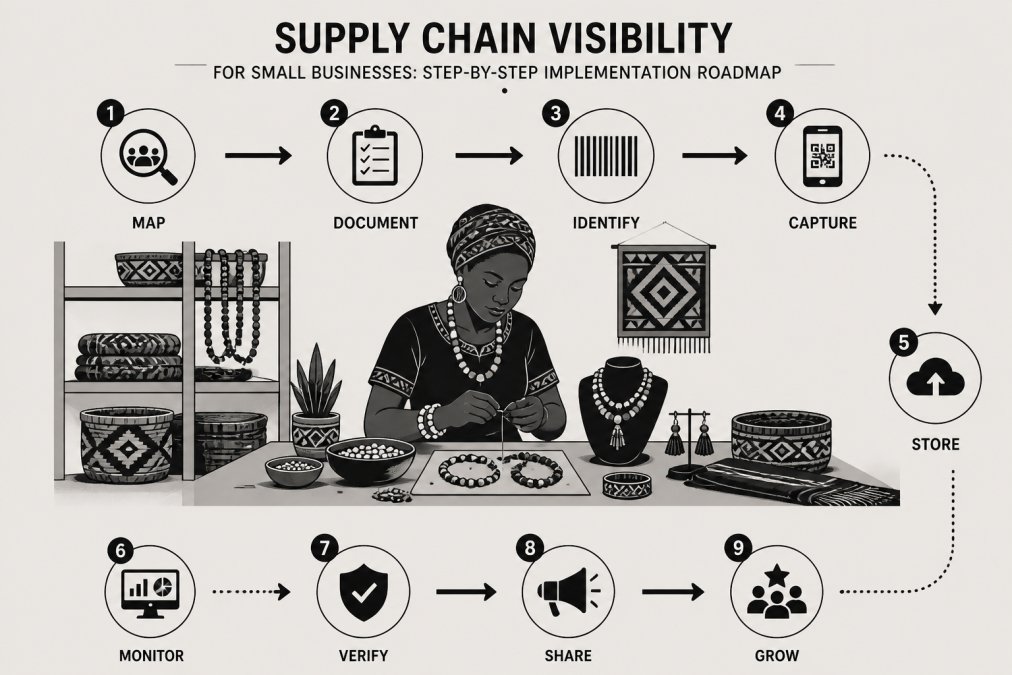
Supply Chain Visibility for Small Businesses: A Step-by-Step Implementation Roadmap
Step 1: Map your current artisan network and material sources
Begin by creating a simple map of everyone and everything involved in your production: all artisans involved (names, contact information, location), all material suppliers (names, location, what they supply), and the production workflow. For each artisan, record their role. For each supplier, record what materials they provide and how long you've worked with them. This map reveals gaps in your knowledge and production steps lacking clear responsibility.
Step 2: Document production lifecycle and create audit trails
Create a simple template for each product recording: material purchased (what, from whom, when, cost), production hours (who worked, how many hours, what wage), quality checks, finishing, packaging, and shipping date. Take photographs at each major step, ideally showing the artisan's face and hands at work. Store photographs digitally with clear filenames.
Step 3: Choose tools that fit your budget and scale
Most artisans should start with free or low-cost options: Google Sheets for data, Google Drive or Dropbox for photographs, and a simple website or social media for sharing stories. If producing fewer than 50 pieces per month, these free tools are sufficient. If producing 50-200 pieces per month, consider a simple website ($100-300/year). If producing more than 200 pieces per month, specialized supply chain transparency software may be justified.
Step 4: Communicate findings to customers and stakeholders
Documentation is only valuable if customers know about it. Create a system for sharing transparency information: QR codes linking to production photos, blog posts about your process, printed cards with products, or email updates to repeat customers.
| Implementation Step | Timeline | Frequency | Tools Needed |
|---|---|---|---|
| Map artisan network and suppliers | 1-2 weeks | One-time | Spreadsheet, phone calls |
| Document production lifecycle | Ongoing | Per product | Camera, spreadsheet, templates |
| Create photography system | 1 week | Per production batch | Smartphone, cloud storage |
| Choose transparency platform | 2-4 weeks | One-time | Website or software platform |
| Share customer stories | Ongoing | Weekly/monthly | Social media, email, website |
Examples of Transparent Artisan Brands and What They Do Right
How real brands use provenance and storytelling
Brands that excel at transparency tell compelling stories about why transparency matters. Each product includes the artisan's name, a photo of them at work, information about their community, and details about what the customer's purchase supports. The most effective transparent brands share the artisan's voice directly, transforming a transaction into a relationship.
Verification methods that go beyond marketing claims
Truly transparent brands include verification mechanisms that customers can actually use: third-party audit reports, timestamped workshop photographs, or direct contact information for independent verification. Some brands invite customers to visit workshops, the ultimate verification. Others partner with nonprofit organizations that conduct independent audits, verifying that wages meet documented standards and working conditions are safe.
Common Challenges in Transparent Artisan Supply Chains and How to Overcome Them
Mapping artisan networks in informal economies
Most artisan production happens in informal economies where official records are sparse. Work within the informal system rather than trying to formalize it completely. Document the relationships that exist: who works with whom, what materials are exchanged, what payments are made. Use photographs, personal testimonies, and relationship records rather than formal contracts. Building trust within informal networks takes time; suppliers may be suspicious of documentation efforts. Explain why documentation matters and how it benefits everyone by increasing market value.
Data integrity and preventing fraud in documentation
Once you create documentation systems, fraud risk emerges. The most effective fraud prevention method is making documentation difficult to falsify retroactively. Photograph production as it happens with timestamps. Record wages contemporaneously, not weeks later from memory. Independent verification provides additional fraud prevention; when a third party reviews documentation and confirms it matches reality, fraud becomes riskier.
Balancing compliance requirements with artisan capacity
Start simple and scale only as needed. A single artisan should spend no more than 5-10% of their time on documentation. If documentation consumes 20% of their time, the system is too complex. Simplify by eliminating unnecessary data points, automating where possible, and accepting that sustainable documentation is more valuable than perfect documentation.
How Transparent Artisan Supply Chains Benefit Your Business and Communities
Operational efficiency through supply chain integrity
When you document your supply chain thoroughly, you gain visibility into inefficiencies previously hidden. You might discover materials are purchased at inflated prices from a supplier out of habit, or that production bottlenecks occur at specific steps. This visibility allows data-driven decisions: negotiate better prices with documented evidence, identify which artisans are most efficient, and spot quality issues early. Operational efficiency also reduces waste and increases profitability, allowing you to pay artisans better wages while maintaining healthy margins.
Risk mitigation and regulatory compliance
Regulatory scrutiny around supply chain ethics is increasing globally. Transparent, documented supply chains protect you from regulatory risk and reputational damage. If a problem emerges, you can quickly identify which products are affected and respond decisively. You have documentation proving you took reasonable steps to verify supplier practices, which protects you from liability.
Direct impact on artisan welfare and community development
The most important benefit is direct impact on artisan welfare. When customers understand exactly how their money is used, they're willing to pay premium prices. This premium translates into higher wages for artisans, improving their lives and their families' lives. Transparent supply chains create accountability; when you've publicly committed to fair wages and documented how much you're actually paying, you can't quietly reduce wages without customers noticing.
Transparent artisan supply chains don't emerge by accident. They require deliberate documentation, consistent verification, and honest communication with customers. You don't need expensive technology or complex systems to start. You need commitment to the process and willingness to document what you're already doing.
At Prideful Pieces of Africa, we've seen how transparency transforms relationships between makers and customers. When a customer can see the artisan's face, read their story, and know exactly how their purchase impacts their life, something shifts. Get started by mapping your current network, documenting one production cycle completely, and sharing that story with customers.
Frequently Asked Questions
What does supply chain transparency mean for artisans?
Supply chain transparency means artisans and the businesses that sell their work openly document and share where materials come from, how products are made, who made them, and what wages were paid. For artisans, this creates proof of fair labor practices, authentic craftsmanship, and ethical sourcing. Customers can trace a piece back to the maker, and artisans gain protection against counterfeit claims and unfair competition.
How can small artisan businesses implement artisan traceability solutions without expensive software?
Start simple: photograph each piece with the maker's name and date, keep written records of material sources, and document production steps. Use free or low-cost tools like Google Sheets for tracking, QR codes linked to product stories, or simple digital documentation via photos and notes. Many small makers begin with paper records and digital photography before moving to specialized software. The key is consistency and honesty, not technology complexity.
What verification methods prove that ethical sourcing claims are real?
Real verification goes beyond self-reporting. Look for third-party audits, fair trade certifications, direct artisan interviews (video or written), wage documentation, material source receipts, and production photos. Transparent brands share payment breakdowns, artisan stories with names and locations, and allow customer contact with makers. Some use blockchain audit trails or third-party inspection reports. The strongest proof combines multiple methods, not just one claim.
Why is supply chain visibility important for customers buying artisan products?
Visibility helps customers verify that their purchase actually supports artisans and communities as promised. It answers key questions: Is this truly handmade? Are workers paid fairly? Where did the materials come from? Without transparency, customers cannot distinguish authentic ethical brands from those using 'ethical' as marketing. Visibility builds trust, justifies premium pricing, and ensures money reaches the people who made the piece.
This article was written using GrandRanker