

Unique Handcrafted Gifts for Social Impact: 2026 Guide
Table of Contents
- What Are Unique Handcrafted Gifts for Social Impact?
- How to Evaluate Handcrafted Gifts: Our Selection Criteria
- Gifts That Give Back: Artisan Collections Making Real Change
- Ethical Gifts That Support Marginalized Communities
- Artisan-Made Gifts: Handcrafted Excellence With Purpose
- Sustainable Gifts: Eco-Friendly & Regenerative Practices
- Curated Gift Boxes for Corporate & Personal Giving
- Which Handcrafted Gift Is Right for Your Impact Goals?
Unique Handcrafted Gifts for Social Impact: 2026 Guide
Last Updated: July 24, 2026
When you choose unique handcrafted gifts for social impact, you're funding education, clean water access, and dignified livelihoods for artisans in underserved communities. At Prideful Pieces of Africa, we've spent years curating collections that prove impact and authenticity aren't marketing buzzwords; they're measurable outcomes tied to every purchase. This guide shows you how to evaluate, select, and give gifts that actually change lives, backed by transparent sourcing and real community outcomes.
What Are Unique Handcrafted Gifts for Social Impact?
Unique handcrafted gifts for social impact are artisan-made products created by skilled craftspeople in developing communities, designed to deliver exceptional quality while channeling revenue directly to the makers. Unlike mass-produced alternatives, each piece carries a story, shaped by specific hands, benefiting specific families, and supporting specific communities.
These gifts span multiple categories: handcrafted jewelry and accessories, fair-trade home decor made from sustainable materials, women-empowered products from cooperative networks, and youth empowerment initiatives that teach traditional crafts to the next generation. The core distinction is transparency. Ethical gift companies publish impact reports showing exactly where money flows, which communities receive support, and what outcomes have been achieved.
Prideful Pieces of Africa exemplifies this model. Each handcrafted piece is shaped by a single artisan in East Africa, never a machine. Your purchase directly supports a family in Kenya, contributes to a child's school day, and provides a village with clean water. No two pieces are identical, meaning you're giving something genuinely one-of-a-kind while preserving generations of tradition, culture, and identity.
How to Evaluate Handcrafted Gifts: Our Selection Criteria
Evaluating handcrafted gifts requires moving beyond aesthetics. Three critical dimensions separate genuinely impactful purchases from greenwashing: transparency about impact, fair compensation verification, and recipient alignment.
Impact Transparency & Verification Badges
The most important question is simple: Can you verify the impact claim? Legitimate impact brands provide specific metrics, not vague promises. Look for these verification signals:
Fair Trade Certification. Organizations like Fair Trade Federation and World Fair Trade Organization conduct independent audits and publish verified supplier lists. Fair Trade Federation standards and certified producers verify that artisans receive minimum wages, work in safe conditions, and have access to community development funds.
Artisan Story Documentation. Companies that genuinely support artisans share specific names, photos, and outcomes. Prideful Pieces of Africa ties each piece to the individual artisan who crafted it, allowing buyers to see exactly whose hands shaped their gift.
Third-Party Impact Reports. Established nonprofits like Global Goods Partners and Ten Thousand Villages publish annual impact reports detailing wages paid, families supported, and community outcomes achieved.
Budget-Specific Filtering & Fair-Wage Verification
Price alone doesn't indicate fair wages. A $50 bracelet might pay the artisan $3, while a $25 handmade candle might pay the maker $12. Fair-wage verification requires asking specific questions: What percentage of the retail price goes directly to the artisan? Ethical brands disclose this ratio. Ten Thousand Villages commits to fair prices that typically represent 40-50% of retail cost to the artisan cooperative. For budget-conscious gifting, handcrafted jewelry and accessories typically offer better artisan margins than mass-produced home goods. A $20-30 fair-trade bracelet might pay an artisan $8-12, while a $15 fair-trade candle might pay only $3-4 due to production costs.
Recipient-Based Segmentation
The best gift aligns with both your values and the recipient's identity. Consider cultural authenticity: Is the recipient from the culture the artisans represent? Prideful Pieces of Africa celebrates East African traditions and identity, ideal for recipients who connect to that heritage or who actively seek to support African artisans. Also consider lifestyle fit and values alignment, does the recipient actually wear jewelry or use home decor, and do they care about impact?
Gifts That Give Back: Artisan Collections Making Real Change
East African Handcrafted Jewelry & Apparel
East African artisans produce distinctive handcrafted jewelry, blending traditional beadwork with contemporary design. Each piece reflects generations of skill passed down through families, combined with modern aesthetics that appeal to global audiences.
Prideful Pieces of Africa specializes in this category, offering handcrafted jewelry, apparel, and accessories that celebrate East African culture and identity. Every piece is shaped by a single artisan's hands, never a machine. By purchasing, you directly support a family in Kenya, contribute to a child's education, and provide clean water to villages where artisans live.

Fair Trade Home Decor & Lifestyle Items
Fair-trade home decor extends impact beyond jewelry into spaces where recipients spend their daily lives. From handwoven textiles to ceramic dishes to hand-poured candles, these products combine aesthetic appeal with community support.
Ten Thousand Villages' fair trade home goods collection offers handcrafted home decor from artisans in 20+ countries, with pricing starting around $9.99 for small items. Prosperity Candle focuses on hand-poured candles made by women refugees and artisans in the U.S., supporting their economic integration. For budget-conscious gifting, fair-trade home decor offers strong value, a $20-30 handwoven placemat or ceramic bowl provides visible daily impact.
Women-Empowered Artisan Products
Women-led cooperatives represent some of the most powerful social impact models in fair trade. Global Goods Partners partners with over 60 women-led cooperatives across Asia, Africa, and the Americas, with pricing starting at $8 for felt items. By design, their model ensures women control production, pricing, and community investment decisions. When you buy from women-empowered collections, you're funding not just individual livelihoods but intergenerational change.
Ethical Gifts That Support Marginalized Communities
Youth Empowerment Through Artisan Work
Youth empowerment initiatives teach traditional crafts to young people in communities where economic opportunities are limited. These programs preserve cultural heritage while creating viable livelihoods for the next generation. When you buy from these brands, a portion of revenue funds apprenticeships, skill-building workshops, and mentorship.
Fair-Trade Certified & Supply Chain Transparency
Fair-trade certification is a verification system backed by independent audits. When you see a fair-trade seal, you're buying from a supplier that has been independently verified to meet strict standards for worker welfare, environmental responsibility, and community development.
SERRV International, one of the world's first fair trade organizations, has partnered with artisans in over 20 countries. Their collection spans home decor, kitchenware, and fashion, with pricing starting at $9.99 for small items. Supply chain transparency means you can trace your purchase from retail back to the artisan.
Artisan-Made Gifts: Handcrafted Excellence With Purpose
One-of-a-Kind Pieces Shaped by Skilled Hands
The defining characteristic of artisan-made gifts is uniqueness. When a single skilled craftsperson shapes a piece entirely by hand, no two items are identical. This uniqueness carries real value, both aesthetically and philosophically.
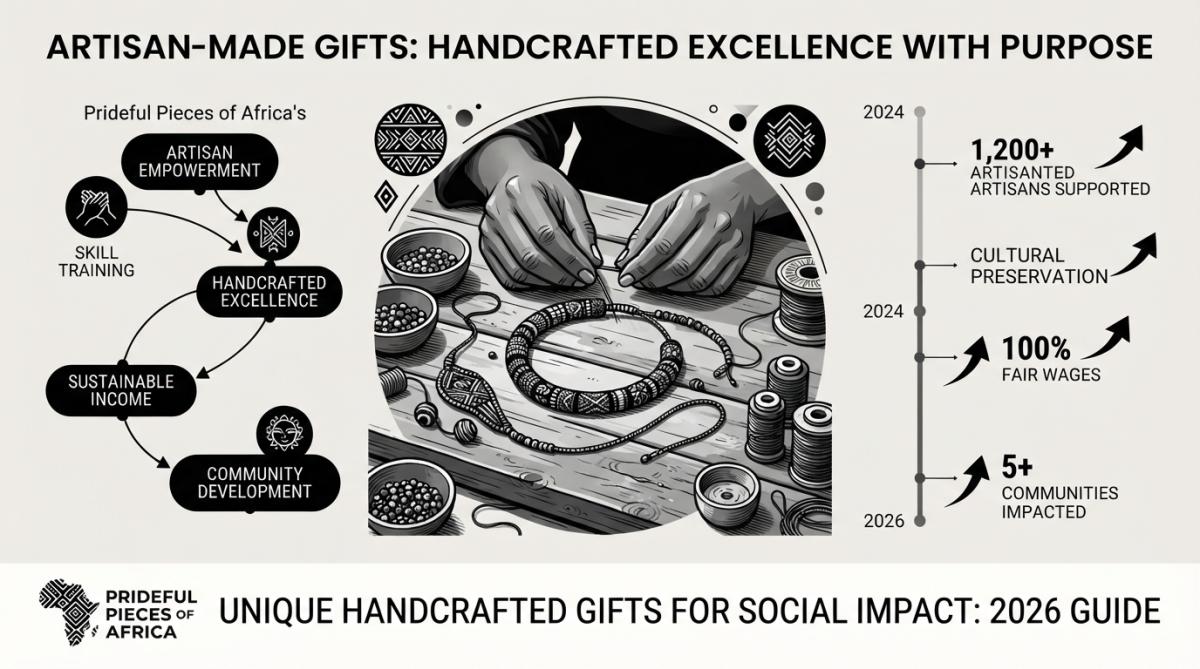
NOVICA, partnered with National Geographic, connects customers directly with over 20,000 master artisans globally. Their platform showcases handcrafted jewelry, apparel, home decor, and art, with pricing starting at $14.99 for jewelry items. The handcrafted model also supports cultural preservation, traditional techniques are kept alive when artisans can earn sustainable incomes practicing them.
Preserving Cultural Traditions & Identity
Artisan-made gifts carry cultural meaning that mass-produced items cannot. A handwoven textile embodies generations of weaving technique. By purchasing these pieces, you're directly funding cultural preservation.
Prideful Pieces of Africa explicitly centers this mission: each piece preserves generations of tradition, culture, and identity from East African communities. When artisans can earn sustainable livelihoods creating culturally rooted work, they choose to stay in their communities and pass skills to the next generation.
African Unique operates as an international marketplace connecting consumers globally with authentic African products, including fashion, beauty, artifacts, and household goods. By supporting African businesses and artisans directly, the platform ensures that cultural products remain rooted in their communities of origin.
Sustainable Gifts: Eco-Friendly & Regenerative Practices
Natural Materials & Environmental Responsibility
Sustainable handcrafted gifts prioritize environmental stewardship alongside social impact. Many fair-trade artisans work with natural materials by necessity, which becomes an advantage: handwoven textiles use natural fibers; ceramic pieces use clay; beadwork uses sustainable materials.
MudLOVE creates handcrafted clay products with a dual mission: providing clean water access and supporting survivors of sex trafficking. Their clay bracelets start at $10, and every purchase funds water infrastructure in the Dominican Republic.
Small-Batch Production & Conscious Consumerism
Small-batch, handcrafted production is inherently more sustainable than mass manufacturing. When items are made in limited quantities by individual artisans, waste is minimized and each piece receives attention that assembly-line production cannot match.
Fair Trade Winds curates a selection of fair-trade and sustainable gifts and home decor items, emphasizing artisanal production and ethical sourcing. By focusing on small-batch items from global artisans, they support a consumption model that prioritizes quality, meaning, and impact over quantity.
Curated Gift Boxes for Corporate & Personal Giving
Curated gift boxes solve a common problem: How do you give meaningful gifts at scale without sacrificing authenticity? Thoughtfully assembled boxes combine multiple artisan products into a cohesive gifting experience.
For corporate gifting, curated boxes demonstrate that your company values ethical practices and supports marginalized communities. Many fair-trade organizations offer corporate customization, allowing you to select products, add company messaging, and order in bulk.
Which Handcrafted Gift Is Right for Your Impact Goals?
Budget-Conscious Gifting With Maximum Impact
If budget is your constraint, focus on categories where artisans earn the highest percentage of retail price. Handcrafted jewelry and small accessories typically offer better artisan margins than larger home goods.
A $20-30 fair-trade bracelet might pay an artisan $8-12, while a $15 fair-trade candle might pay only $3-5 due to production costs. For maximum impact per dollar, prioritize jewelry, small textiles, and accessories. Ten Thousand Villages and Global Goods Partners both offer entry-level items starting under $10. Another strategy: buy directly from artisans when possible through NOVICA and African Unique, which often reduces intermediary markups.
| Budget Level | Best Category | Typical Price | Artisan Margin |
|---|---|---|---|
| Under $15 | Small accessories, felt items | $8-14 | 40-50% |
| $15-30 | Handcrafted jewelry, candles | $15-28 | 35-45% |
| $30-50 | Apparel, larger home goods | $30-48 | 30-40% |
| $50+ | Statement jewelry, art pieces | $50+ | 25-35% |
Corporate Gifting That Reflects Your Values
Corporate gifting with impact requires intentionality. Generic corporate gifts signal indifference; thoughtful, ethically sourced gifts signal that your company genuinely values its recipients and the communities you support.
Start by identifying your impact priority: Do you want to support women artisans? Youth empowerment? Environmental sustainability? Specific geographic regions? Once you've defined your priority, select a fair-trade partner that aligns with it. Request customization options: branded packaging, personalized cards explaining the impact, or artisan profiles included in each box. For large orders, negotiate directly with fair-trade organizations. Global Goods Partners, SERRV International, and Ten Thousand Villages all have corporate gifting programs. Budget $20-40 per recipient for meaningful corporate gifts.
Personal Gifting: Recipient Preferences & Cultural Authenticity
Personal gifting allows for more specificity. Start with these questions: Does the recipient wear jewelry? Use home decor? Connect to specific cultures? Care about impact narratives?
For recipients who value impact and connect to East African culture, Prideful Pieces of Africa offers handcrafted jewelry and apparel that directly support artisans in Kenya while preserving cultural traditions. For recipients who prioritize environmental sustainability, Prosperity Candle's hand-poured candles made by women refugees offer both eco-friendly materials and a powerful social mission. For recipients who value global artisan support without specific geographic preference, NOVICA's vast selection of handcrafted goods from 20,000+ artisans worldwide offers something for nearly any aesthetic or budget.
| Recipient Profile | Best Brand | Why It Works |
|---|---|---|
| Values East African culture and impact | Prideful Pieces of Africa | Direct artisan support, cultural authenticity, one-of-a-kind pieces |
| Cares about environmental sustainability | Prosperity Candle | Natural materials, women's empowerment, clear social mission |
| Wants global artisan support | NOVICA | 20,000+ artisans, direct connection, transparent pricing |
| Prefers home decor and lifestyle items | Ten Thousand Villages | Wide selection, fair trade certified, affordable entry points |
| Prioritizes women's empowerment | Global Goods Partners | 60+ women-led cooperatives, verified fair wages, transparent impact |
Choosing unique handcrafted gifts for social impact requires moving beyond aesthetics to ask: Where does my money go? Who benefits? Can I verify the impact claim? Prideful Pieces of Africa answers these questions transparently. Each handcrafted piece is shaped by a single artisan in East Africa, directly supporting families, funding education, and providing clean water to communities. By choosing ethically sourced, artisan-made gifts, you're not just giving a beautiful object, you're funding dignity, preserving cultural heritage, and creating economic opportunity in communities that need it most. Shop Prideful Pieces of Africa and give gifts that carry real meaning.
Frequently Asked Questions
How do I know if a handcrafted gift actually supports artisans fairly?
Look for fair-trade certifications, supply chain transparency statements, and impact reports from the seller. Legitimate brands disclose wage structures, working conditions, and community benefits. Prideful Pieces of Africa, for example, provides clear documentation of how purchases support families in Kenya, education, and clean water access. Ask sellers for proof, reputable artisan-focused companies willingly share these details.
What's the difference between ethical gifts and mass-produced alternatives?
Ethical gifts are handcrafted by artisans earning fair wages, often with transparent supply chains and regenerative practices. Mass-produced alternatives prioritize cost and volume over artisan welfare or environmental impact. Handcrafted gifts support marginalized communities, preserve cultural traditions, and create dignified employment. While prices may be higher, your purchase directly empowers families and funds education, healthcare, and clean water initiatives in artisan communities.
Are sustainable gifts more expensive than regular handcrafted gifts?
Sustainable handcrafted gifts typically cost more than mass-produced items due to fair wages, eco-friendly materials, and small-batch production. However, pricing varies widely based on materials, artisan location, and complexity. Many options exist across budget ranges, from affordable felt flowers and small accessories starting around $8-$10 to premium jewelry pieces. The higher cost reflects true value: artisan livelihoods, environmental responsibility, and cultural preservation.
How can I verify that a brand's social impact claims are authentic?
Check for third-party certifications like Fair Trade Federation membership or B Corp status. Request impact reports, artisan stories, and wage transparency. Visit the brand's website for specific community partnerships, named organizations, and measurable outcomes (e.g., 'provides clean water to X families'). Authentic brands provide verifiable details and often feature artisan names and photos. Compare claims across competitors and read customer reviews mentioning real impact experiences.
Can I wear handcrafted gifts from other cultures without appropriating them?
Yes, when you purchase from authentic artisan sources directly supporting those communities. Wearing handcrafted pieces from East African artisans, for example, becomes cultural appreciation when your purchase funds education and livelihoods in those regions. The key is intentionality: buy from legitimate artisan sellers, learn the piece's cultural significance, and honor the craftsmanship. Avoid fast-fashion knockoffs claiming 'African-inspired' designs that don't benefit actual artisans.
This article was written using GrandRanker