

Why Choose Handmade Over Mass-Produced Jewelry
Table of Contents
- Why Choose Handmade Over Mass-Produced Jewelry: The Core Differences
- The Benefits of Handmade Jewelry You Won't Find Elsewhere
- Unique Handmade Jewelry: Individuality and Personal Connection
- Ethical Jewelry Choices: Supporting Artisans and Communities
- Disadvantages of Mass-Produced Jewelry: What You're Avoiding
- How to Identify Authentic Handmade vs. Mass-Market Imitations
- Handmade Jewelry as a Meaningful Investment
- Conclusion: Making the Case for Handmade
Last Updated: July 21, 2026
When considering jewelry purchases, understanding why handmade outperforms mass-produced matters more than ever. At Prideful Pieces of Africa, we've witnessed how handcrafted pieces transform personal style and entire communities. The distinction between artisan-made and factory-produced jewelry goes far deeper than aesthetics, it touches on craftsmanship, ethics, durability, and meaning. This guide explores concrete reasons why discerning buyers increasingly choose handmade jewelry and what you gain when you invest in pieces shaped by human hands rather than machines.
Why Choose Handmade Over Mass-Produced Jewelry: The Core Differences
Craftsmanship vs. Automation
When an artisan crafts jewelry by hand, every decision, from metal thickness to stone placement to finishing touches, reflects their skill and experience. A master jewelry maker might spend hours on a single piece, adjusting proportions and refining details using techniques passed down over generations.
Mass production operates on entirely different principles. Machines stamp out identical pieces from molds and apply finishes through chemical baths. The process prioritizes speed and cost reduction. A factory might produce hundreds of identical rings in the time a single artisan completes one custom piece.
Quality Control and Precision
Handmade jewelry involves continuous quality control by the maker themselves. An artisan immediately notices if a solder joint isn't clean or if a stone sits off-center, correcting issues before the piece leaves their workshop because their reputation depends on every item.
Mass manufacturing uses statistical quality control, accepting a certain percentage of defects as normal. When you buy mass-produced jewelry, you're accepting that probability. Precision also differs meaningfully, an artisan adjusts techniques in real time based on specific material properties, while machines follow rigid programs regardless of variation.
The Benefits of Handmade Jewelry You Won't Find Elsewhere
Durability and Longevity
Durability is determined by construction, not materials alone. A handmade piece built with proper techniques will outlast mass-produced alternatives made from identical materials. Artisans typically use superior construction methods that create stronger pieces. A hand-set stone might be secured with multiple tiny prongs carefully shaped to grip it, whereas mass-produced settings often use minimal metal to reduce costs.
A skilled artisan who made your piece understands exactly how it was constructed and can repair it properly. Mass-produced jewelry often requires replacement of entire components because the construction doesn't allow for targeted repair.
Investment and Resale Value
A mass-produced ring loses 60-70% of its retail value immediately upon purchase. Handmade pieces, particularly those from respected artisans or cultural traditions, often appreciate or maintain value. Vintage handmade jewelry from established artisans commands premium prices at auction. The artistry, cultural significance, and scarcity create lasting demand.
If circumstances change, you can recover a meaningful portion of your investment. The piece becomes an asset, not merely an expense.
Maintenance and Repairability
When your handmade piece needs maintenance, a skilled artisan can restore it to original condition through re-polishing, resetting stones, or strengthening weakened joints. Mass-produced jewelry often reaches a point where repair costs exceed replacement cost.
A handmade piece can be maintained indefinitely because construction methods are timeless. This sustainability matters enormously, a piece you wear for 50 years and pass to your child has far lower environmental impact than mass-produced pieces you replace every 3-5 years.
Unique Handmade Jewelry: Individuality and Personal Connection
One-of-a-Kind Designs and Customization
Mass production demands standardization. You receive something identical to thousands of other people. Handmade jewelry allows genuine customization. You can collaborate with an artisan to create something reflecting your specific vision, cultural heritage, or personal story.
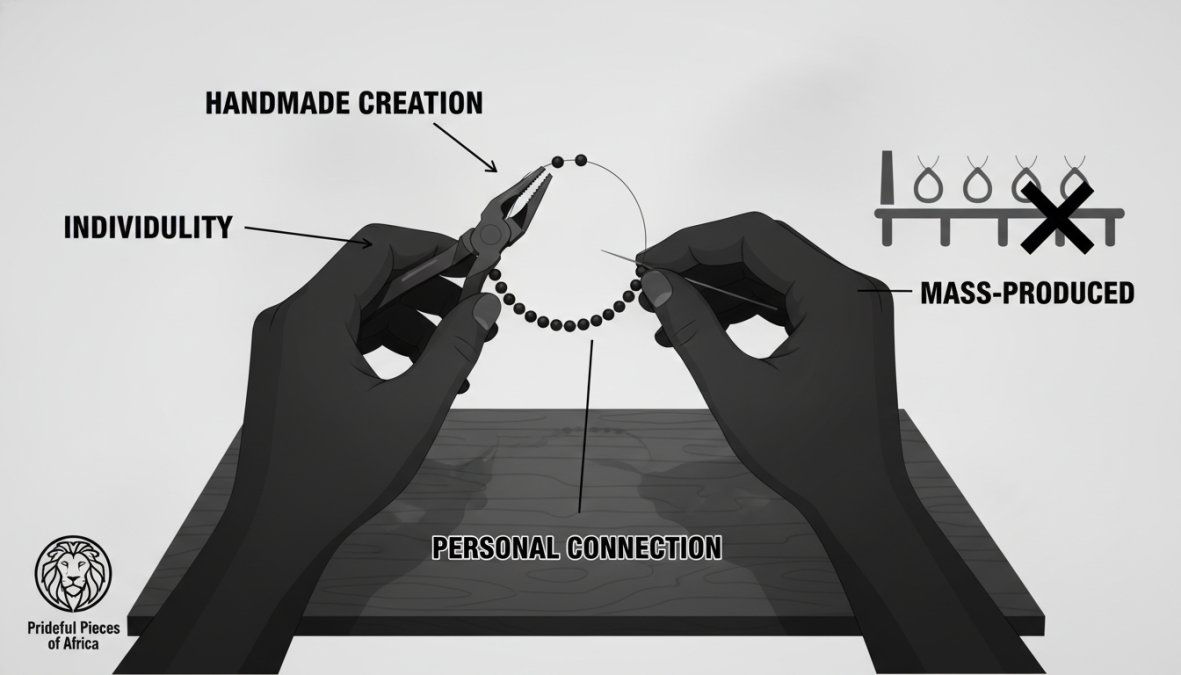
The result is a piece nobody else owns. In a world of mass-produced sameness, wearing something truly unique carries psychological weight. Customization also means pieces can incorporate personal elements, initials, dates, family symbols, or cultural motifs, that transform jewelry from decoration into personal statement.
The Story Behind Each Piece
Every handmade item carries a narrative. You know who made it, where it was made, what materials were selected, and why certain design choices were made. When you wear a handmade piece from Prideful Pieces of Africa, you're wearing East African cultural heritage shaped by an artisan whose family has practiced these techniques for generations.
Research shows objects with stories carry more emotional weight. You value something more deeply when you understand its origins. A handmade piece has a story you can tell and feel connected to. This storytelling aspect also creates accountability, an artisan's reputation depends on their work, unlike factory production where individual workers have no direct relationship to the final product.
Ethical Jewelry Choices: Supporting Artisans and Communities
Fair Wages and Transparent Sourcing
The jewelry industry has serious ethical problems at scale. Mass manufacturing often involves exploitative labor practices, unsafe working conditions, and insufficient wages. Mining operations extract precious metals and gemstones using practices that devastate environments and exploit workers.
Handmade jewelry from ethical sources operates transparently. You know who made your piece, under what conditions they worked, and what compensation they received. Artisans working for organizations like Prideful Pieces of Africa receive fair wages reflecting the true value of their skilled labor. Your purchase directly supports families and communities.
A fair-trade artisan might earn 5-10 times what factory workers earn for comparable work. That difference represents food security, children's education, healthcare access, and dignified living conditions.
Environmental Lifecycle and Sustainability
Mass jewelry production creates substantial environmental damage across its entire lifecycle. Mining destroys ecosystems and contaminates water supplies. Manufacturing uses harsh chemicals and high energy. Most pieces end up in landfills within years.
Handmade jewelry has a fundamentally different environmental profile. Artisans often source materials carefully, work with smaller quantities, and create pieces designed for longevity. A piece you wear for 50 years has dramatically lower environmental impact than five mass-produced pieces you replace every decade.
Many artisans working in traditional crafts use sustainable practices developed over generations. They understand material properties deeply and waste minimally.
Disadvantages of Mass-Produced Jewelry: What You're Avoiding
Quality Control Failures and Hidden Costs
Mass-produced jewelry frequently exhibits quality problems that emerge after purchase. Stones fall out because settings weren't secure. Clasps break because they were engineered to fail. Metal becomes brittle because manufacturing shortcuts weakened its structure.
Over 20 years, you might buy ten mass-produced pieces at $200 each, spending $2,000 total. A $500 handmade piece you wear for 20 years costs less and provides far more satisfaction. This applies especially to pieces you wear regularly, engagement rings, wedding bands, everyday necklaces, which experience constant stress.
Ethical and Environmental Concerns
The true cost of mass-produced jewelry includes human suffering and environmental destruction never reflected in the price tag. Workers endure unsafe conditions for insufficient wages. Gemstone mining displaces communities and destroys ecosystems. These externalities are real costs borne by vulnerable populations.
Supporting mass production means participating in these systems. Handmade jewelry from ethical sources inverts this model, your purchase directly supports artisans and their communities, with prices reflecting fair compensation and sustainable practices.
How to Identify Authentic Handmade vs. Mass-Market Imitations
Signs of True Artisan Craftsmanship
Authentic handmade jewelry displays characteristics distinguishing it from mass production: slight variations in symmetry, visible tool marks showing intentional technique, variable surface texture reflecting hand-finishing, and construction prioritizing durability over cost reduction.
Examine stone settings closely. Hand-set stones typically feature multiple secure contact points with visible prongs carefully shaped to grip the stone. Mass-produced settings use minimal metal and often employ adhesives that fail over time.
Check metal weight and density. Handmade pieces typically use fuller metal sections. A hand-forged ring feels substantial and balanced. Ask about construction details, a legitimate artisan can explain exactly how your piece was made and why certain techniques were chosen.
Verifying Cultural Authenticity and Fair Practices
When purchasing handmade jewelry from specific cultural traditions, verify authenticity by asking whether the artisan actually practices that tradition. For pieces claiming ethical production, request verification. Legitimate organizations like Prideful Pieces of Africa provide transparency about artisans, communities, and impact.
Check for third-party verification. Reputable fair-trade organizations certify ethical practices. If a seller claims fair practices but lacks independent verification, that's a warning sign. Ask direct questions: How much does each artisan earn? What percentage of your purchase price goes to the maker? What community benefits result?
Handmade Jewelry as a Meaningful Investment
Choosing handmade jewelry represents a shift in how you think about personal adornment. Instead of treating jewelry as disposable fashion, you're investing in pieces with lasting value, both economic and emotional. A handmade piece becomes part of your personal narrative.
This investment mentality changes behavior. You care for the piece more carefully because it matters more. You wear it regularly because you appreciate its quality and meaning. You pass it forward because it's genuinely worth inheriting.
| Aspect | Handmade Jewelry | Mass-Produced Jewelry |
|---|---|---|
| Initial Cost | Higher | Lower |
| Lifespan | 30-70+ years | 3-10 years |
| Repairability | Excellent | Limited |
| Resale Value | 50-80% retained | 20-40% retained |
| Environmental Impact | Low (durability) | High (replacement cycle) |
| Customization | Full | Limited/None |
| Ethical Sourcing | Transparent | Often exploitative |
| Emotional Connection | Strong | Weak |
| Total Cost of Ownership | Lower | Higher |
When you calculate true cost over time, handmade jewelry consistently proves more economical. The higher upfront investment is recovered through longevity, repairability, and resale value.
The choice between handmade and mass-produced jewelry ultimately reflects your values and priorities. If you want pieces that last, that carry meaning, that support artisans fairly, and that maintain value, handmade jewelry is the clear choice. Prideful Pieces of Africa offers handcrafted jewelry embodying these principles, each piece meticulously shaped by skilled artisans in East Africa. When you choose Prideful Pieces of Africa, you're not just purchasing jewelry; you're supporting families, preserving cultural traditions, and investing in pieces designed to become heirlooms.
Fair Trade Jewelry Standards and Certification
Environmental Impact of Jewelry Manufacturing
Artisan Jewelry Craftsmanship and Quality Standards
Frequently Asked Questions
What is the difference between handmade and mass-produced jewelry?
Handmade jewelry is crafted by skilled artisans using traditional techniques, with each piece receiving individual attention and customization. Mass-produced jewelry relies on automated manufacturing processes, where identical pieces are created in bulk with minimal human intervention. Handmade pieces often show slight variations and marks of individual craftsmanship, while mass-produced items are uniform. The manufacturing process directly impacts quality control, durability, and the personal connection to the maker, key reasons why choose handmade over mass-produced jewelry.
Why is handmade jewelry more expensive than mass-produced options?
Handmade jewelry costs more because skilled artisans invest significant time and expertise in each piece. Labor-intensive techniques, ethical sourcing of materials, fair wages, and quality control all contribute to higher pricing. Additionally, artisans often use superior precious metals and gemstones with greater integrity. Mass-produced jewelry achieves low prices through automation, volume manufacturing, and sometimes compromised ethical practices. The investment in a handmade piece reflects its durability, uniqueness, and the direct support you provide to artisan communities.
How can I verify that jewelry is truly handmade and ethically sourced?
Look for makers who provide transparent information about their artisans, sourcing practices, and production methods. Authentic handmade pieces often show minor imperfections or variations, signs of individual craftsmanship. Reputable brands share stories about the artisans behind each piece and offer documentation of fair wages and ethical sourcing. Ask for proof of impact: reports on community support, education funding, or water access initiatives. Be cautious of mass-market brands claiming 'handmade' without verifiable artisan information or cultural connection.
Are the benefits of handmade jewelry worth the higher cost?
Yes, for most buyers. Handmade jewelry offers superior durability, longevity, and investment value compared to mass-produced alternatives. Each piece is unique, carries cultural or personal meaning, and often appreciates or maintains value over time. Beyond personal benefits, your purchase directly supports artisan families, education, and community infrastructure, creating measurable positive impact. If you wear jewelry regularly and value quality, craftsmanship, and meaningful consumption, the higher initial cost is offset by the piece's lasting value and the real-world impact of your purchase.
This article was written using GrandRanker