

Impact of Fair Trade on Jewelry Supply Chains
Table of Contents
- What Fair Trade Means for Jewelry Supply Chains
- How Ethical Jewelry Sourcing Standards Build Transparency
- The Benefits of Fair Trade Gold for Artisanal Miners
- Economic Empowerment and Community Development in Mining Regions
- Environmental Stewardship and Decarbonization in Jewelry Production
- Blockchain and Digital Ledgers: New Tools for Traceability
- Measuring Impact After Purchase and the Recycled Gold Debate
- Frequently Asked Questions
Last Updated: September 16, 2026
What Fair Trade Means for Jewelry Supply Chains
Fair trade in jewelry is a certification and business model guaranteeing minimum prices, safe working conditions, and community investment for those who mine, cut, and craft precious materials. The impact of fair trade on jewelry supply chains reaches from a single miner's daily wage to the resilience of entire communities. This guide from Prideful Pieces of Africa examines how ethical sourcing standards are reshaping the industry.
The core problem is visibility. A gold ring may pass through a dozen hands across three continents before reaching a display case, and most transactions leave no paper trail. Fair trade interrupts that opacity with a chain of custody: documented proof of where materials came from and who handled them.
From Mine to Market: How the Chain Works
The jewelry supply chain runs from artisanal and small-scale mining through local traders, refiners, manufacturers, and retailers. Each stage introduces risk, from unsafe extraction to labor rights violations.
Fair trade certification addresses this by establishing traceability at the point of extraction. According to the Fairtrade International standards for gold and precious metals, certified operations must meet requirements covering working conditions, environmental management, and democratic organization. The OECD Due Diligence Guidance for Responsible Supply Chains of Minerals provides the international framework many certification bodies build on.
How Ethical Jewelry Sourcing Standards Build Transparency
Ethical jewelry sourcing standards make every transaction auditable. Third-party auditing verifies fair wages, no child labor, and that mercury or cyanide use meets environmental thresholds.
In practice, a certified piece carries documented provenance: you can trace the gold to a specific cooperative, not just a country. Country-level claims are nearly impossible to verify; cooperative-level records can be inspected.
| Supply Chain Stage | Fair Trade Requirement | Verification Method |
|---|---|---|
| Mining | Fair wage, safe conditions | On-site third-party auditing |
| Trading | Documented chain of custody | Paperwork and digital records |
| Refining | Conflict-free certification | Independent inspection |
| Manufacturing | Labor rights compliance | Regular compliance reviews |
| Retail | Traceability disclosure | Certification label and reports |
The Benefits of Fair Trade Gold for Artisanal Miners
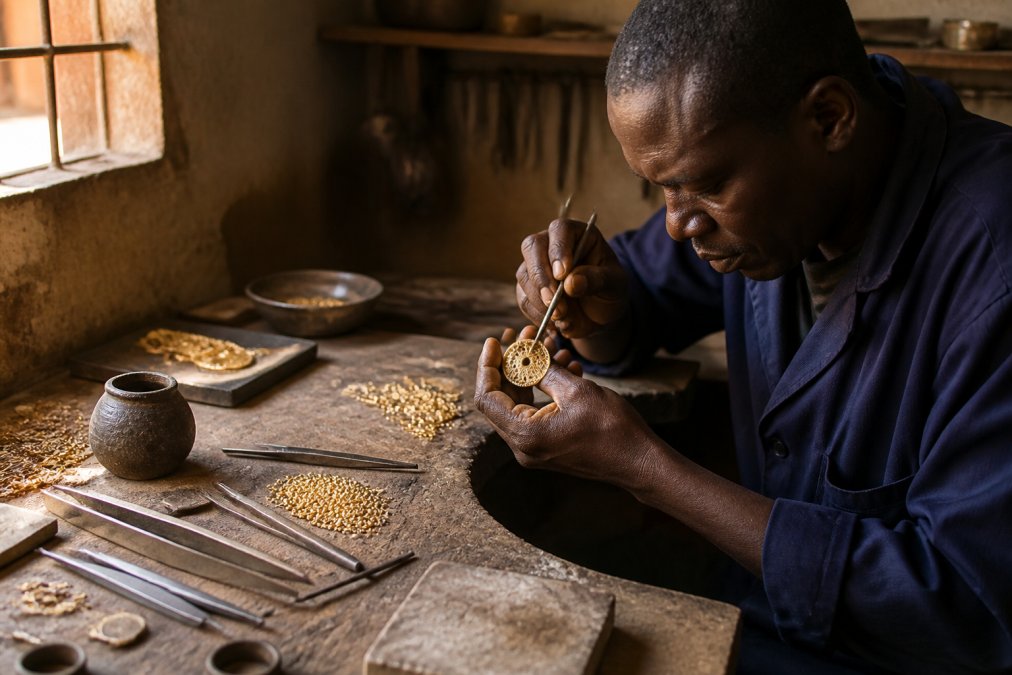
The benefits of fair trade gold center on price stability and community premiums. Certified miners receive a guaranteed minimum price that protects them when markets fall, plus a premium their cooperative votes on how to spend.
That premium often funds community development: a school, a clean water system, a clinic. Stable income lets families invest in education and health rather than surviving day to day.
Economic Empowerment and Community Development in Mining Regions
Economic empowerment in mining regions depends on more than wages. It requires social equity: women having equal access to mining roles and leadership, and communities having a voice in decisions about land and resources. But the mechanism that actually moves income is the price floor and the premium.
How the Price Floor and Premium Actually Work
Fair trade gold operates on a two-part payment structure. First, a guaranteed minimum price set above the volatile spot market protects miners when commodity prices fall. Second, a social premium is paid per gram on top of the minimum price. The cooperative, not an outside charity or the buyer, votes on how to spend it.
That governance detail is the part most summaries skip. A cooperative voting to build a clinic exercises collective decision-making, itself a form of economic empowerment; one voting to buy a shared processing machine invests in productivity. Both are legitimate; the choice sits with the miners.
Inclusive Business Models and the Intermediary Problem
Inclusive business models that purchase directly from cooperatives cut out intermediaries who historically captured most of the value. When a cooperative sells directly, a larger share of the retail price returns to the people who did the work. That is the mechanism behind "fair wage", not charity, but a restructured value chain.
The intermediary problem is real and measurable in structure. A typical artisanal gold chain includes a pit-level buyer, a regional trader, a city-based dealer, an exporter, and a refiner before the metal reaches a manufacturer. Each layer takes a margin. Direct purchasing collapses several layers into one transaction, and that margin can instead be split between the cooperative and the buyer.
The Barriers That Limit Reach
Fair trade certification does not scale automatically, and the reasons are structural rather than ideological.
TEMBO AFRICA Maasai Beaded Earrings →
- Credit access. Artisanal miners often sell to the first buyer who offers cash because they cannot wait for a better price. Without access to working capital, a price floor is only useful if the miner can hold out long enough to receive it.
- Formalization and licensing. Cooperatives need legal recognition, mining permits, and bank accounts to participate in certified supply chains. In many regions, the paperwork burden falls hardest on the smallest operators.
- Mercury dependency. Miners who rely on mercury amalgamation to recover fine gold may lack the equipment and training to switch to mercury-free methods, which some certification standards require.
- Gender exclusion. Women are frequently concentrated in the least-paid stages of artisanal mining, such as crushing and washing ore, and are underrepresented in cooperative leadership. Certification standards that require democratic organization can help, but only if women are actually admitted as members.
What This Means for Buyers
A brand that wants its purchasing to empower mining communities should ask three questions: Does the cooperative set its own premium spending priorities? Are women represented in cooperative leadership? Does the brand's purchasing volume give the cooperative enough stability to plan beyond the next sale? A single order does not transform a value chain; a repeatable, contracted relationship does.
Environmental Stewardship and Decarbonization in Jewelry Production
Environmental stewardship in jewelry production covers two fronts: how materials are extracted and how much energy manufacturing consumes. Unregulated artisanal mining can contaminate waterways with mercury and silt. Certified operations must follow environmental management plans that limit chemical use and restore land after extraction.
The Extraction Front: Mercury, Cyanide, and Tailings
The most consequential environmental issue in artisanal and small-scale gold mining is mercury. It binds fine gold particles into an amalgam, and much is lost during burning and washing. Mercury persists in waterways, accumulates in fish, and damages nervous systems. Certification standards that prohibit amalgamation, or require enclosed retorts capturing mercury vapor, address the problem at its source.
Cyanide leaching is the other chemical concern, used mainly at larger operations. Certified refiners and mines must follow cyanide management practices that prevent spills and protect groundwater. Tailings must be stored in engineered facilities rather than released into rivers or piled where rain can carry them into streams.
Land reclamation is the third leg. A properly closed mine should have its pits backfilled, topsoil restored, and site replanted. This is expensive and slow, so certification standards typically require a reclamation plan and sometimes a financial bond forfeited if the operator walks away.
The Manufacturing Front: Energy and Emissions
Decarbonization is the newer pressure point. Refining and manufacturing are energy-intensive, and downstream consumers increasingly ask brands to account for emissions. The United States Environmental Protection Agency's guidance on responsible mineral sourcing outlines how environmental compliance intersects with mineral supply chains for regulated industries.
A useful way to think about emissions is to separate them into three buckets:
- Scope 1, direct emissions from owned or controlled sources, such as fuel burned at a mine or foundry.
- Scope 2, indirect emissions from purchased electricity, such as a refinery drawing from a coal-heavy grid.
- Scope 3, all other indirect emissions in the value chain, including the transport of ore, the production of chemicals, and the shipping of finished jewelry.
For most jewelry brands, Scope 3 dwarfs the other two, so credible decarbonization claims start with supplier engagement rather than facility-level changes. Switching an office to renewable power is real, but it does not address the bulk of the footprint.
The Circular Economy Overlay
A circular economy approach, where recycled metals replace newly mined material, reduces extraction pressure.
Blockchain and Digital Ledgers: New Tools for Traceability
Measuring Impact After Purchase and the Recycled Gold Debate
Frequently Asked Questions
What does fair trade mean in the context of jewelry?
Fair trade in jewelry means artisans and miners receive fair wages, work in safe conditions, and have a voice in decisions. It also involves environmental protections and community investment. For example, a fair trade certified gold mine must meet standards for labor rights, no child labor, and responsible chemical use.
How can consumers verify if their jewelry is ethically sourced?
Look for third-party certifications like Fairtrade International. Ask brands for supply chain transparency reports or traceability details. Some companies use blockchain to track a piece from mine to market. If a brand can't explain where its materials come from, that's a red flag.
What is the difference between ethical jewelry and fair trade jewelry?
Ethical jewelry is a broad term covering environmental and social responsibility. Fair trade jewelry specifically meets certification standards that guarantee fair wages, safe working conditions, and community development. A piece can be ethical without formal fair trade certification, but fair trade certification provides independent verification.
How does fair trade impact the pricing of handcrafted jewelry?
Fair trade jewelry often costs more because it includes fair wages, safer mining practices, and community premiums. However, that extra cost supports education, clean water, and healthcare in mining communities. Many buyers see it as an investment in positive impact.