

The History of Kenyan Traditional Dress: A 2026 Guide
Table of Contents
- Kenyan Traditional Dress: From Hides and Sisal to Cotton and Beads
-
The Traditional Attire of Kenyan Tribes: Regional Differences and Identity
- Pastoralist Communities: Maasai, Samburu, and Turkana
- Highland Farming Communities: Kikuyu, Kamba, and Meru
- Coastal Swahili Communities: Kikoi, Kanzu, and Buibui
- Forest and Lake Communities: Fiber-Based Dress
- What the Differences Reveal
- The Maasai Shuka: Origins and Cultural Significance
- Kitenge and Khanga: Modern Traditional Staples
- Cultural Symbolism in East African Clothing: Beads, Colors, and Status
- Gender-Specific Evolution in Kenyan Traditional Dress
- Handmade East African Apparel for Women: Preservation and Economic Impact
- Traditional Weaving Techniques and Indigenous Craftsmanship
- Conclusion
- Frequently Asked Questions
Last Updated: September 13, 2026
Kenyan Traditional Dress: From Hides and Sisal to Cotton and Beads
The history of Kenyan traditional dress begins long before cotton reached the coast, with communities shaping clothing from animal hides, sisal fiber, raffia, and leather. This guide from Prideful Pieces of Africa traces that history from pre-colonial everyday wear through trade, colonization, and the rise of the Maasai shuka, kitenge, and khanga as symbols of identity. What emerges is not a single national costume but a mosaic of tribal identity and ancestral traditions that still shapes how people dress today.
Before imported fabric, garment construction was regional and resource-driven. Communities in cooler highland areas favored treated hides and leather cloaks, while those near water and forest used plant fibers. Smithsonian National Museum of African Art collection overview documents how animal hides and skins served as the primary material for daily wear across East Africa.
Pre-Colonial Materials and Everyday Wear
Everyday dress before colonization was practical first. Hunters and herders wore softened hides treated with animal fat; sisal skirts were common among farming communities, while raffia and bark cloth appeared where those materials grew. Ornamentation mattered as much as coverage: beadwork, brass wire, and cowrie shells signaled age, marital status, and clan. These garments were never static, styles shifted with seasons, ceremonies, and trade contact long before Europeans arrived.
How Trade and Colonization Changed Clothing
Indian Ocean trade routes brought cotton, silk, and printed cloth to the coast centuries before formal colonization. Arab, Persian, and later Portuguese and British traders introduced woven textiles that gradually replaced hides in some regions while coexisting with them in others. Colonization accelerated the shift: imported cotton became cheaper, and mission schools often discouraged indigenous dress. Yet Kenyan traditional dress did not disappear, it adapted, absorbing new fabrics into existing ceremonial and status systems.
The Traditional Attire of Kenyan Tribes: Regional Differences and Identity
The traditional attire of Kenyan tribes reflects geography, economy, and social structure as much as aesthetics. More than forty distinct communities developed recognizable dress traditions, and those differences remain a point of pride today. Dress was never a single "tribal costume", it was a working system in which material, cut, and ornament answered to climate, livelihood, and social rank.
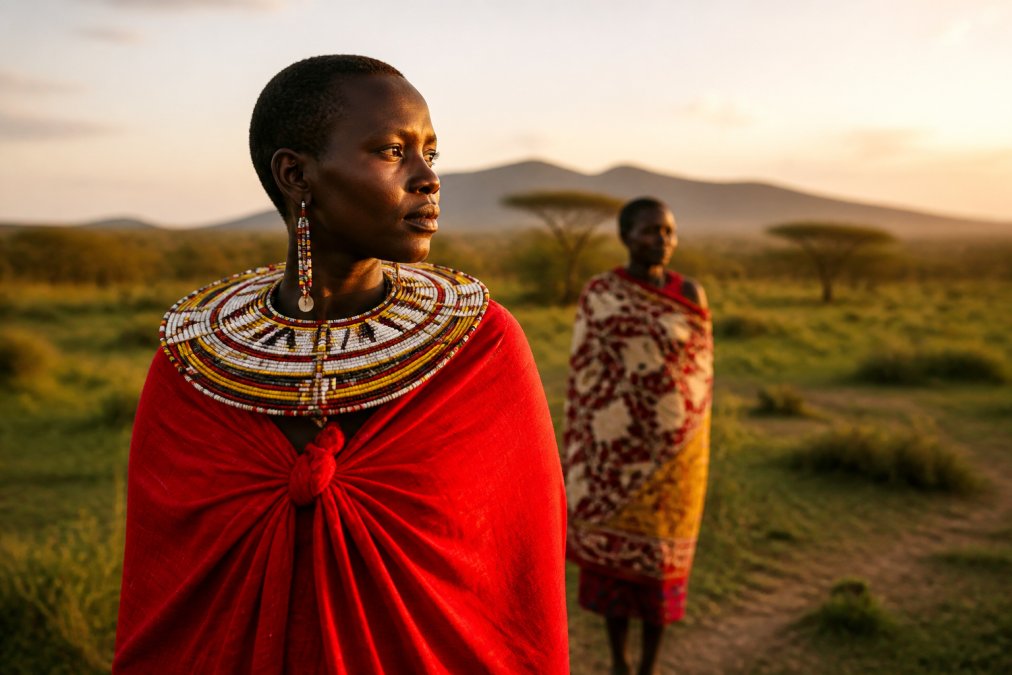
Pastoralist communities like the Maasai and Samburu favored draped cloth and elaborate beadwork. Highland farmers developed leather garments and, later, cotton wraps. Coastal communities shaped by Swahili trade adopted the kikoi and kanzu. The table below summarizes how materials and styles diverged by region and livelihood.
| Community Type | Primary Materials | Signature Garments | Status Markers |
|---|---|---|---|
| Pastoralist | Hides, red cloth, beads | Shuka, beaded collars | Bead color, age grade |
| Highland farming | Leather, cotton | Hide cloaks, wraps | Brass and copper wire |
| Coastal Swahili | Imported cotton, kikoi | Kikoi, kanzu, buibui | Fine fabric, embroidery |
| Forest and lake | Raffia, sisal, bark cloth | Sisal skirts, fiber wraps | Shell and seed ornamentation |
Pastoralist Communities: Maasai, Samburu, and Turkana
Among the Maasai, dress is a public record of age grade and clan. Uncircumcised boys wore little beyond a simple cloth; after initiation, a young moran (warrior) adopted the red shuka, a beaded collar, and a spear, while elders shifted to darker cloth and walking sticks. Samburu men wore a cloth wrap knotted over one shoulder and layered beaded necklaces that grew more elaborate with age. Turkana women favored leather skirts and aprons decorated with ostrich-shell beads and metal rings, a style tied to the region's drier, livestock-based economy.
Highland Farming Communities: Kikuyu, Kamba, and Meru
In the central highlands, cool weather and agricultural work shaped dress around treated leather. Kikuyu men wore a goatskin or sheepskin cloak fastened at the shoulder, while women wore leather skirts and, later, cotton wraps as trade cloth reached inland markets. Kamba communities incorporated brass and copper wire into belts and armbands, a visible marker of wealth where metal was scarce. Meru dress followed a similar leather-and-wrap pattern, with beadwork on collars and waistbands.
Coastal Swahili Communities: Kikoi, Kanzu, and Buibui
Centuries of Indian Ocean trade gave the coast a distinct dress vocabulary. Men wore the kanzu, a long white or cream tunic, often under a jacket for formal occasions. Women wore the kikoi, a rectangular woven wrap, and the buibui, a full-length black public cover. Fine imported cotton, silk, and embroidery signaled status: detailed neckline stitching marked a man of means, a hand-finished border a woman of standing.
Forest and Lake Communities: Fiber-Based Dress
Communities near forests and lakes, including groups around Lake Victoria and the western highlands, relied on plant materials where hides were less available. Raffia and sisal were shredded, twisted into cord, and woven into skirts and wraps, while bark cloth beaten from fig tree bark served as soft everyday fabric in some areas. Ornamentation leaned on shells, seeds, and locally worked metal rather than imported beads.
What the Differences Reveal
The pattern is consistent: dress tracked livelihood. Herders needed cloth that could be draped and removed quickly; farmers needed durable leather that resisted thorns and weather; coastal traders needed fabric that signaled participation in a wider commercial world. That is why there is no single "Kenyan traditional dress", only regional systems that still inform how people dress today.
The Maasai Shuka: Origins and Cultural Significance
The Maasai shuka is a draped cloth, usually red, worn wrapped across the body. Its origins are often misattributed to purely indigenous weaving: the bright red fabric became widely adopted after imported cloth reached the region, then the Maasai made it their own. Red symbolizes bravery and unity; blue, black, and checkered patterns carry clan and ceremonial meaning. Today the shuka is one of East Africa's most recognizable markers of tribal identity.
Kitenge and Khanga: Modern Traditional Staples
Kitenge and khanga are printed cotton fabrics that became central to Kenyan traditional dress in the twentieth century. Khanga, a rectangular wrap often printed with a Swahili proverb, developed along the coast and became everyday wear for women. Kitenge, a heavier printed cloth, is used for formal garments, headwraps, and tailored outfits. Both carry messages: a khanga's proverb can comment on marriage, warning, or celebration without a word spoken.
Cultural Symbolism in East African Clothing: Beads, Colors, and Status
Cultural symbolism in East African clothing operates on multiple levels at once: color, material, pattern, and adornment each carry meaning that insiders read instantly, one of the richest and most overlooked dimensions of the region's dress history.
Beadwork and Jewelry Symbolism
Beadwork is more than decoration. Among Maasai and Samburu communities, bead colors encode meaning: red for bravery and blood, white for peace and purity, blue for the sky and water, green for the land and health. Beaded collars, earrings, and bracelets also mark age grades and life transitions. The Metropolitan Museum of Art's essay on African adornment notes that beadwork often functioned as a form of record-keeping, encoding family history and social standing in wearable form.
The Role of Textiles in Social Status
Textiles have long served as status symbols. A finely woven kikoi or imported silk kanzu signaled wealth on the coast, while elaborate beadwork and brass ornamentation marked standing in pastoralist societies. Social hierarchy was legible at a glance. That logic persists today, visible in the difference between a mass-produced print and a handcrafted piece made by a single artisan.
Gender-Specific Evolution in Kenyan Traditional Dress
Men's and women's dress evolved along different tracks. Men's attire tended toward draped cloth, tunics, and practical leather garments suited to herding and travel. The dashiki, a loose pullover shirt with embroidered neckline, became popular across East Africa in the mid-twentieth century as a symbol of post-colonial identity, and remains a staple in men's wardrobes.
Women's dress absorbed more of the trade-driven innovation. Khanga and kitenge wraps, kaftans, and headwraps offered a wider vocabulary of pattern and color, becoming a primary vehicle for personal style and cultural pride. Women's traditional dress today therefore carries more visible variation than men's, and changes faster.
Handmade East African Apparel for Women: Preservation and Economic Impact
Handmade East African apparel for women is where cultural preservation and economic impact intersect most directly: when a garment is made by hand, the money stays closer to the maker, and the techniques get passed to the next generation rather than lost.
That economic dimension is often ignored in fashion writing. Textile and craft production supports households, funds school fees, and keeps specialized skills alive. Buying handmade is not charity; it is a direct transaction that values indigenous craftsmanship at a fair price. Prideful Pieces of Africa pays fair wages and uses transparent, regenerative practices so each purchase supports a family and preserves generations of tradition. As one customer put it, "Knowing my piece supports a family in Kenya makes wearing it feel sacred." If you want a piece that carries this history, a handcrafted TEMBO AFRICA Maasai Beaded Earrings brings beadwork symbolism into everyday wear, while a patchwork kaftan dress with matching headwrap carries kitenge and khanga motifs into a modern silhouette.
If you want a piece that carries this history, a handcrafted TEMBO AFRICA Maasai Beaded Earrings brings beadwork symbolism into everyday wear, while a patchwork kaftan dress with matching headwrap carries kitenge and khanga motifs into a modern silhouette.
Traditional Weaving Techniques and Indigenous Craftsmanship
Traditional weaving techniques in East Africa vary by material and community, but share a common logic: every step is done by hand and learned by apprenticeship rather than instruction manuals. That is also why the techniques are fragile, when a maker stops working, the knowledge often stops with them. This section covers the main material chains and the preservation question most overviews skip.
Sisal and Raffia: From Leaf to Cord
Sisal and raffia are harvested, shredded, and hand-twisted into cord before weaving. The fiber is soaked, beaten, and sun-dried to soften it, then rolled against the thigh into a continuous strand. Weavers work on the ground or a simple frame, tensioning by hand. The resulting cloth is coarse but durable, which is why sisal and raffia were common for skirts, mats, and storage bags in farming and lakeside communities.
Bark Cloth: Beaten, Not Woven
Bark cloth is not woven at all. It is beaten from fig tree bark into a soft, felted sheet: the inner bark is stripped, soaked, and pounded with a wooden mallet on a log anvil until the fibers interlock. The process takes hours and produces a distinctive textured surface. Bark cloth served as everyday wraps in some forest communities and ceremonial pieces in others.
Cotton: Spinning, Dyeing, and Narrow-Loom Weaving
Cotton is spun and woven on narrow handlooms, then hand-dyed with plant and mineral pigments. The narrow loom produces strips roughly a hand wide, sewn edge to edge to create a full cloth. Dye sources include roots, leaves, bark, and local minerals. Colorfastness depends on the mordant used, which is why some traditional dyes fade with washing while others hold for years.
Beadwork as a Parallel Craft
Beadwork follows its own production chain. Glass beads are sorted by color and size, then strung on sinew or thread and stitched onto leather or cloth. Among Maasai and Samburu makers, a single beaded collar can take days to complete, and the pattern is often memorized rather than drawn. The Metropolitan Museum of Art's essay on African adornment notes that beadwork often functioned as a form of record-keeping, encoding family history and social standing in wearable form.
Why Preservation Is Not About Freezing Styles
UNESCO's Intangible Cultural Heritage programme recognizes traditional craft knowledge of this kind as living heritage worth protecting, and that framing matters. When a weaving or beading technique disappears, the knowledge goes with it. Preservation is not about freezing styles in place; it is about keeping the skills in use so they can evolve. A common pattern among younger makers is to pair inherited techniques with contemporary silhouettes, a hand-twisted sisal cord used in a modern bag, or a beaded collar worn with a tailored jacket. That is how the craft stays alive without becoming a museum piece.
Conclusion
The history of Kenyan traditional dress is a story of adaptation, not preservation under glass. Hides gave way to imported cotton, cotton gave way to printed kitenge and khanga, and through every shift communities kept their symbols intact. That history is still being made, and you can wear a piece of it. Prideful Pieces of Africa offers handcrafted jewelry, apparel, and accessories made by skilled artisans, with no two pieces alike, fair wages, and transparent sourcing. Get started with Prideful Pieces of Africa and wear a piece of history that supports a family, a child's school day, and a village's clean water.
Frequently Asked Questions
What is the traditional dress of Kenya?
Traditional Kenyan dress varies by tribe. The Maasai wear the shuka, a red blanket-like wrap, with extensive beadwork. Kikuyu women historically wore animal hides and sisal skirts, while coastal communities like the Swahili adopted kikoi and khanga cloths through trade. Today, many Kenyans wear these garments for ceremonies and cultural events, while kitenge and khanga remain everyday staples across the country.
What did Africans wear before colonization?
Before colonization, many East African communities wore clothing made from animal hides, sisal skirts, and raffia. Body adornment with beads, cowrie shells, and ochre was common. Trade with Arab and Indian merchants introduced cotton and woven fabrics along the coast. Colonization later brought Western-style clothing and changed daily dress, but traditional materials and styles survived in ceremonial contexts and rural areas.
How did colonization influence traditional clothing in East Africa?
Colonization introduced Western dress codes, Christianity, and imported textiles. Missionaries encouraged modest clothing, and colonial schools often banned traditional attire. This pushed many Kenyans to adopt shirts, dresses, and trousers. However, traditional garments like the shuka and kitenge persisted, and after independence, they were reclaimed as symbols of national and tribal identity.
What is the significance of beadwork in traditional Kenyan dress?
Beadwork carries deep cultural meaning in Kenyan communities. Among the Maasai, colors and patterns indicate age, marital status, and social position. For example, red beads symbolize bravery and unity, white represents peace, and blue stands for the sky and water. Beaded jewelry is worn during ceremonies and everyday life, and today it supports indigenous craftsmanship and cultural preservation.