

Why East African Textile Art Matters Today: A 2026 Guide
Table of Contents
- East African Textile Art as a Visual Language
- From Traditional Motifs to Subversive Design
- Handmade East African Apparel for Women: Craft, Identity, and Daily Wear
- Ethical Sourcing in African Fashion: What It Looks Like in Practice
- East African Textile Art in the Global Art Market
- Preserving Cultural Heritage: Digital Archives and Regional Variations
- Conclusion: Wearing the Story Forward
- Frequently Asked Questions
Last Updated: September 10, 2026
East African Textile Art as a Visual Language
East African textile art matters today because it functions as a visual language, communicating identity, status, memory, and social commentary through pattern and color. This guide from Prideful Pieces of Africa examines why these traditions remain vital in 2026, from their roots in handwoven cloth to their growing presence in contemporary art and ethical fashion.
Unlike decorative traditions that carry meaning only for their makers, East African textiles speak to anyone willing to learn the vocabulary. A kanga's message, a Maasai bead's color sequence, a Kente strip's geometric code: each is a sentence in a shared visual language that has adapted across generations rather than fossilized.
Below, we'll show you exactly how that language works, where it's heading, and why supporting handmade work keeps it alive.
How Kanga and Other Textiles Communicate Meaning
The Kanga is a rectangular printed cloth, typically sold in pairs, whose border text carries proverbs, warnings, or declarations worn as a public statement (si.edu). A woman selecting a kanga for a wedding, a funeral, or a market day is choosing what her clothing will say before she speaks.
That communicative function extends across the region's textile traditions:
- Beaded jewelry encodes age, marital status, and ceremonial role through color order
- Woven cloth patterns signal lineage and occasion
- Printed proverb cloths allow wearers to comment on relationships and community events without confrontation
Most guides treat these as folkloric details. In practice, they are a working communication system, and reading it correctly changes how you see every piece.
From Traditional Motifs to Subversive Design
Traditional motifs never stayed static. Designers across the region have long used pattern as social commentary, shifting a border, recoloring a proverb, or combining motifs from different communities to question fixed ideas about identity and tradition.
This is the part most people get wrong: they assume "traditional" means unchanging. The historical record shows the opposite. Textile design has absorbed new dyes, new printing methods, and new audiences while keeping its symbolic core intact. Contemporary artists working with fabric push that further, treating cloth as a medium for artistic discourse on gender, migration, and politics rather than as heritage decoration.
For anyone building a wardrobe or collection around east african textile work, that distinction matters. You are not buying a frozen artifact. You are buying into a living design conversation.
Handmade East African Apparel for Women: Craft, Identity, and Daily Wear
Handmade east african apparel for women is clothing shaped by a single artisan rather than a production line, which is why no two pieces match exactly. The appeal is not nostalgia. It is fit, individuality, and a direct link between the wearer and the maker.
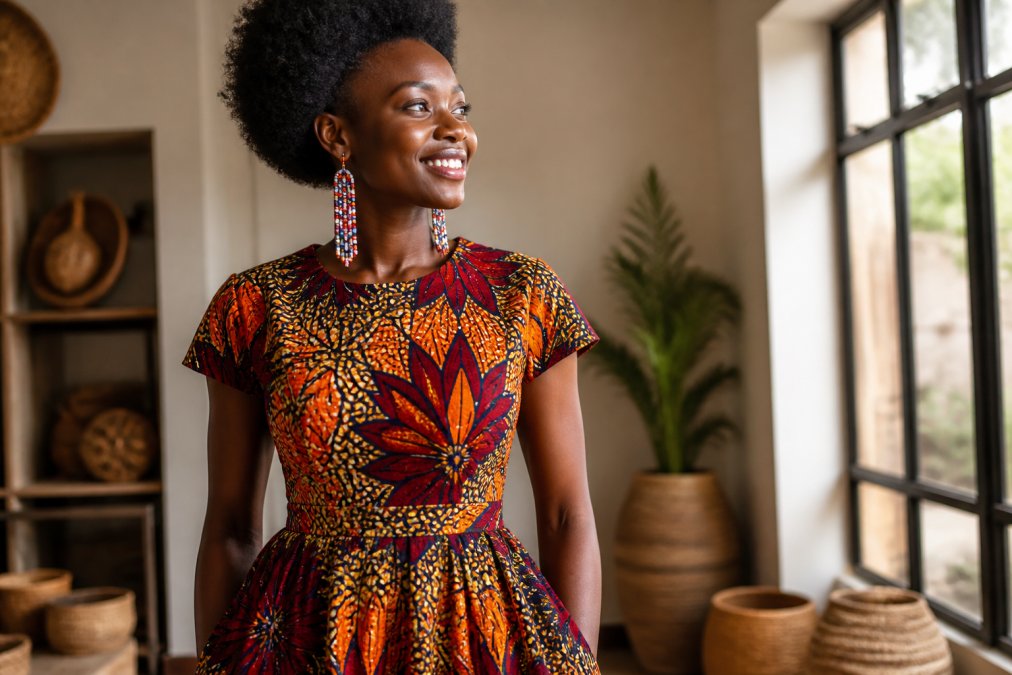
Pieces like a smocked mermaid dress finished with Kente trim, or a multi-strand Ankara shawl necklace, carry pattern choices that a machine-printed garment rarely reproduces faithfully. Handwork also means variation: bead spacing, trim alignment, and fabric drape shift slightly from piece to piece.
Why Handmade Matters in a Mass-Produced Market
Mass production optimizes for identical output. Handmade work optimizes for the individual wearer, and that difference shows in three practical ways:
- Durability: hand-finished seams and beadwork are typically reinforced by the maker, not glued
- Repairability: an artisan who made the piece can usually repair it
- Traceability: you can often name the person who made your garment
A common mistake is treating handmade as a premium aesthetic rather than a supply-chain choice. It is the latter. When you buy handmade, you are choosing who gets paid and how much of the price reaches them.
Ethical Sourcing in African Fashion: What It Looks Like in Practice
Ethical sourcing in African fashion means paying artisans fair wages, sourcing materials transparently, and structuring production so makers keep working in their own communities. It is a set of verifiable practices, not a label.
The Federal Trade Commission's Green Guides set the standard for how environmental and sourcing claims may be marketed in the United States, which is worth knowing when you evaluate any "ethical" label. Vague claims without specifics are a warning sign.
Fair Wages, Regenerative Practices, and Community Impact
Fair wages, regenerative practices, and community impact are the three pillars that separate genuine ethical sourcing from marketing language.
- Fair wages: artisans are paid per piece at rates they agree to, not at whatever the market will bear
- Regenerative practices: production avoids depleting local materials and reinvests in the community
- Community impact: revenue supports essentials like education and clean water where artisans live
Prideful Pieces of Africa structures its model around exactly these three commitments, with each purchase tied to supporting a family, a child's school day, and village water access. That is a concrete claim you can hold a seller to, and you should.
East African Textile Art in the Global Art Market
Global interest in African textile art has grown as collectors and institutions treat cloth as fine art rather than craft. Auction houses, galleries, and museums now present textile works alongside painting and sculpture, and the Smithsonian's National Museum of African Art has long documented textile traditions as central to African artistic heritage. That institutional validation is the single biggest driver of price movement in the category, because it converts a functional object into an authored work with a documented history.
What Actually Drives Value in a Textile Piece
Four factors separate a piece that appreciates from one that sits in a drawer:
- Authorship: a named maker, workshop, or design lineage, not an anonymous pattern
- Provenance: a documented chain of custody, where it was made, by whom, and how it reached the seller
- Condition and originality: intact dyes, unrepaired beadwork, and patterns that have not been reprinted for the tourist trade
- Exhibition or publication history: a piece shown in a gallery, catalogued in a museum collection, or featured in a design publication carries a verifiable record
Most buyers over-index on aesthetics and under-index on provenance. A visually striking kanga with no documented origin is a decorative purchase. The same cloth with a named maker and a paper trail is a collectible. That distinction is the whole game.
How Emerging Artists Enter the Market
This is the part most coverage skips entirely. For a textile artist trying to move from local sales to the global market, the practical path usually runs through a handful of concrete steps:
- Document everything. Photograph each piece at high resolution, record the pattern's name and meaning, the materials, the dyes, and the hours of labor. A digital catalog is the artist's resume.
- Build a provenance file per piece. A signed certificate of authenticity, a maker statement, and dated photographs create the paper trail collectors and galleries require.
- Show in group contexts first. Regional craft fairs, design weeks, and museum-adjacent markets are lower-barrier entry points than solo gallery representation.
- Cultivate a direct-to-buyer channel. Online storefronts and social platforms let artists reach international buyers without surrendering the margin a middleman would take.
- Price for the market you want. Underpricing signals craft; consistent, defensible pricing tied to documented labor and materials signals authorship.
The Uneven Economics, and What Buyers Can Do
The opportunity is real but unevenly distributed. Institutional attention tends to concentrate on a small number of named artists and established workshops, while the broader artisan base that supplies the visual vocabulary rarely captures the upside. Buyers who understand this can shift it: ask who made the piece, ask what share of the price reaches them, and prefer sellers who can answer both questions specifically. When textile work is collected rather than consumed, artisans gain authorship, their patterns become attributed works, not anonymous designs. That shift is the difference between a craft purchase and an economic relationship.
Preserving Cultural Heritage: Digital Archives and Regional Variations
Digital archives are becoming one of the most effective tools for preserving textile patterns, letting researchers and designers document motifs before they are lost to discontinued dyes and printing methods. Photography, high-resolution scanning, and open databases now record pattern histories that once lived only in memory. This is one of the angles most coverage misses entirely. Preservation is not only about keeping cloth in museums. It is about keeping the knowledge of how a pattern was made, and by whom, accessible.
How Digital Preservation Actually Works
The mechanics matter more than the slogan. A pattern survives digitally when four things are captured together:
- The image: high-resolution photography and flatbed scanning of the full cloth, including borders and selvedges where makers often sign or mark their work
- The metadata: the pattern's name, its meaning or proverb, the region and community of origin, the maker, and the date
- The process record: dye recipes, weave structures, bead color sequences, and the tools used, the tacit knowledge that dies with the maker if it is not written down
- Open access: a database that researchers, designers, and descendant communities can actually reach, not a private archive
A common failure mode is capturing the image without the metadata. A photograph of a beautiful cloth with no record of who made it or what it says is decoration, not preservation. The knowledge is the artifact.
How Regional Differences Shape East African Textile Art
Regional differences shape East African textile art through local materials, climate, and community tradition. Coastal communities developed different dye and print practices than highland weaving centers, and beadwork color conventions vary between pastoral and agricultural groups. Generalizing "East African" textiles erases exactly the distinctions that make a piece readable.
A few concrete patterns of variation:
- Coastal and island traditions tend to favor printed cloth with text, the kanga being the clearest example, because Indian Ocean trade routes supplied both the cotton and the printing technology.
- Highland and inland weaving centers developed loom-based cloth traditions shaped by local fiber availability and cooler climates that favored heavier textiles.
- Pastoralist beadwork encodes age, marital status, and ceremonial role through strict color order, with conventions that differ from agricultural communities' beadwork even when the materials are identical.
- Ugandan bark cloth, made from beaten fig-tree bark rather than woven fiber, represents an entirely different production logic, a reminder that "textile" in this region includes non-woven traditions.
Those variations matter for two reasons. First, they make provenance meaningful: where a piece was made tells you how to read it. Second, they keep the broader tradition resilient, because no single region's decline wipes out the whole vocabulary.
If you are buying a piece as a gift or an heirloom, ask where it was made. The answer should be specific, a town, a community, or a named workshop, not a country.
Conclusion: Wearing the Story Forward
Choosing handmade work over mass-produced alternatives is a decision about what you want your clothing to mean, and about who you want your money to reach. Prideful Pieces of Africa makes that choice straightforward with handcrafted jewelry, apparel, and accessories made by skilled artisans, fair wages and transparent sourcing behind every piece, and regenerative practices that support families, education, and clean water in the communities where those artisans live.
Get started with Prideful Pieces of Africa and wear a piece of history that keeps its makers working.
Frequently Asked Questions
What makes East African textile art unique compared to other regions?
East African textile art stands out for its use of visual language. Kanga cloths feature Swahili proverbs, while Maasai beadwork uses color to signal age, status, and identity. Unlike purely decorative traditions, these textiles function as a communication system. The region's weaving techniques, including handwoven cotton and bark cloth, also vary by community, making each piece a carrier of specific cultural heritage rather than a generic African print.
How does wearing handmade East African apparel support artisan communities?
When you buy handmade East African apparel for women, a larger share of your money stays with the maker. Prideful Pieces of Africa pays fair wages and uses transparent, regenerative practices. Each purchase supports a family in Kenya, contributes to a child's school day, and helps provide clean water. Unlike mass-produced items, these pieces are shaped by a single artisan, so your purchase directly sustains their craft and community.
Can someone without East African heritage wear these pieces respectfully?
Yes, if you approach the piece with respect and understanding. Learn the story behind the pattern or beadwork, buy from sources that credit and pay artisans fairly, and avoid treating the item as a costume. Wearing handmade East African apparel for women as everyday fashion, not as a trend, honors the culture. As one customer from Brooklyn said, 'Knowing my piece supports a family in Kenya makes wearing it feel sacred.'
What does ethical sourcing in African fashion actually mean?
Ethical sourcing in African fashion means fair wages, safe working conditions, and transparent supply chains. It also includes regenerative practices that protect local resources. You can verify claims by asking for artisan stories, impact reports, or details on where materials come from. Prideful Pieces of Africa, for example, shares how each purchase supports education and clean water. Look for brands that name their artisans and explain where your money goes.