

East vs West African Jewelry: Key Differences
Table of Contents
- East African vs West African Jewelry: A Quick Comparison
- Traditional East African Jewelry Materials and Techniques
- West African Goldwork and Its Cultural Weight
- The Cultural Significance of African Jewelry in Daily Life
- Regional Styles: From Maasai Beadwork to Akan Gold
- How to Style African Jewelry for Modern Outfits
- Where Each Tradition Wins and How to Choose
- Conclusion
- Frequently Asked Questions
Last Updated: September 8, 2026
East African vs West African Jewelry: A Quick Comparison
East African jewelry and West African jewelry represent two of the continent's most distinctive adornment traditions, yet they could hardly look more different. East African jewelry leans on bold color, beadwork, and natural materials like bone and wood, while West African jewelry is defined by the warm glow of gold and the prestige of intricate metalwork. In this guide, we break down the materials, techniques, and cultural meanings behind each tradition.
African jewelry is far more than decoration. Across the continent, it functions as a language of identity, marking age, marital status, social rank, and spiritual allegiance. For collectors and style-conscious buyers in the United States, understanding these regional differences transforms a purchase from a simple accessory into a meaningful connection to cultural heritage.
Traditional East African Jewelry Materials and Techniques
The Maasai Beadwork Belt (Kenya/Tanzania)
Historically, the Maasai used beads made from local materials, bone, horn, wood, and seeds, but the iconic glass beadwork only emerged after 19th-century trade routes connected the Rift Valley to Indian Ocean ports. Venetian glass beads, often traded through Zanzibar, replaced organic materials because they offered a broader color spectrum and did not fade (britishmuseum.org). The technical signature is the flat, dense stitch: artisans string beads onto a single thread and bind rows together, creating a fabric-like surface. The width of a Maasai woman's beaded collar (often 4 to 6 inches) and the tightness of the weave indicate the time invested, a single collar can take two to three weeks of daily work.
The Ethiopian Silver and Gold Cross Tradition
Orthodox Christian crosses, worn around the neck or pinned to the forehead, are cast or cut from silver, brass, or gold using the lost-wax method, a technique that arrived via Byzantine and later Portuguese influence. The Lalibela cross, named after the rock-hewn churches, features a distinctive openwork design requiring the artisan to carve the negative space in wax before casting. Unlike Maasai beadwork, which is a women's craft, Ethiopian metalwork is a male-dominated guild tradition, with techniques passed from father to son. Silver is associated with purity and the Virgin Mary, while gold is reserved for high-ranking clergy and nobility.
The Swahili Coast Brass and Silverwork (Kenya/Tanzania Coast)
Along the coast, from Mombasa to Zanzibar, a third tradition emerged from the confluence of Bantu, Arab, and Indian Ocean trade. Swahili artisans specialized in filigree, twisting fine silver or brass wire into intricate scrollwork for bracelets, earrings, and kanga-cloth pins. Unlike the Maasai preference for flat color, Swahili work is three-dimensional and reflective, designed to catch light. A distinctive piece is the 'kidole' ring, a thick silver band with a raised rectangular bezel, often engraved with Arabic calligraphy or geometric stars.
The Oromo Amber and Copper Tradition (Ethiopia)
The Oromo people of southern Ethiopia offer yet another material signature: raw amber and copper. Oromo women wear layered necklaces of rough, unpolished amber chunks strung on leather or copper wire. The amber is not faceted or polished, its value lies in its natural, organic form and warm, honey-colored glow. Copper, believed to have healing properties, is often wrapped around the amber or used as spacer beads.
Direct Material Comparison: East vs. West
West African Akan goldweights are cast solid, with dense, sculptural mass (si.edu). East African Maasai beadwork is woven, flat, and lightweight. West African gold is a store of value, it is weighed, measured, and traded. East African beads are a store of social identity, they are read, not weighed. The Sahel and savanna of the east favored lightweight, portable adornment for pastoral communities, while the forest kingdoms of the west accumulated heavy, permanent metal wealth.
This breakdown reveals that 'East African jewelry' is not one style but several. A Maasai collar, a Swahili filigree bracelet, and an Oromo amber necklace share a geographic origin but share almost nothing in material, technique, or cultural function.
West African Goldwork and Its Cultural Weight
West African jewelry tells a different story, one centered on gold and the power of empires. The Akan people of Ghana, along with the kingdoms of Mali and Senegal, developed sophisticated lost-wax casting techniques to create goldweights, pendants, and rings that served as both ornamentation and currency.
Kings and chiefs wore elaborate gold regalia to assert divine right and lineage. Even today, gold jewelry at Akan ceremonies signals status and continuity with ancestors. The craftsmanship is extraordinarily refined, with pieces often featuring intricate spiral motifs and proverbial symbols that communicate wisdom.
Smithsonian National Museum of African Art's overview of Akan goldwork documents how these objects functioned within broader systems of governance and trade, far beyond simple body adornment.
The contrast with the east is stark. Where a Maasai woman's beaded collar announces her community and life stage through color, an Akan chief's gold pendant announces his rank and lineage through material value and symbolic design.
The Cultural Significance of African Jewelry in Daily Life
The cultural significance of african jewelry extends into nearly every major life event. Births, initiations, marriages, and funerals all call for specific pieces that communicate the wearer's role and the community's values.
In many East African communities, jewelry also functions as a store of wealth and a form of currency. Beaded belts and collars can be dismantled and traded, providing economic security for women. Many pieces are also believed to offer protection from harm or to attract fertility and good fortune.
Cowrie shells, used across both regions, historically served as currency along trade routes, linking adornment directly to commerce. Trade beads, introduced through exchanges with European and Arab merchants, were quickly absorbed into local aesthetics.
Regional Styles: From Maasai Beadwork to Akan Gold
The visual gap between regions is the easiest way to identify a piece's origin. Maasai beadwork from the east is flat, colorful, and expansive, often covering the neck and chest in wide collars. Akan goldwork from the west is sculptural, dense, and metallic, designed to catch light and signal prestige.
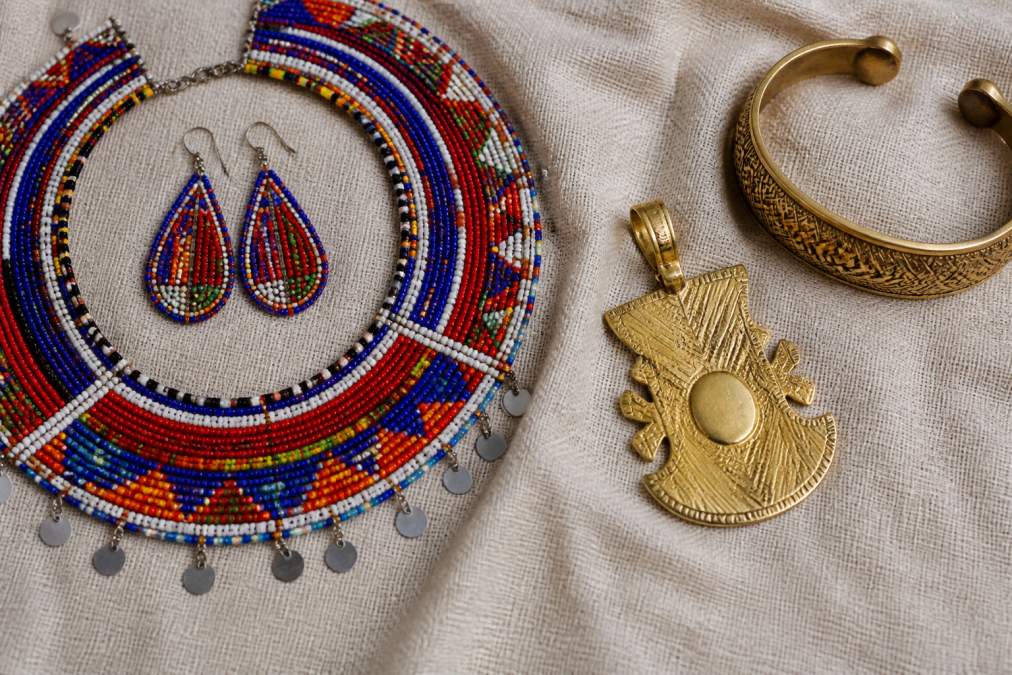
Ethiopian silver crosses offer a third eastern style, while the Tuareg people of the Sahara, straddling both spheres, produce silver jewelry with distinctive cross motifs. Kenyan coastal jewelry often incorporates influences from Swahili and Omani trade, while inland Maasai pieces remain more insular in design.
For the modern consumer, this variety is an advantage. East African styles offer a pop of color and a bohemian energy that pairs well with casual and festival wear. West African gold pieces function as heirloom-quality statement items that elevate formal attire.
How to Style African Jewelry for Modern Outfits
Styling traditional African jewelry in a contemporary American wardrobe is about understanding the physical properties of each piece and letting those properties dictate the outfit.
Material Properties Dictate the Outfit
Maasai beadwork is flat and wide. A full collar sits on the collarbone and extends outward, covering the upper chest. It does not hang; it rests. This means it requires a neckline that shows skin, a boat neck, a strapless top, or a simple crew neck with the collar sitting above the fabric. The weight is distributed across the shoulders, so it is comfortable for hours, but it will not work under a blazer or a high-necked sweater. The color palette (often red, blue, green, and orange) demands a neutral base. For a subtler entry point, start with Maasai beaded earrings, they are lightweight, swing with movement, and add a pop of color without the commitment of a full collar.
Swahili filigree is dense and metallic. These silver or brass pieces are heavier than they look because the wire is tightly coiled. A filigree bracelet or pendant has a formal weight that suits structured fabrics, a linen blazer, a silk blouse, or a tailored dress. The reflective surface catches light, so it pairs well with matte textures like cotton or wool. Unlike Maasai beadwork, which is casual, Swahili filigree reads as 'fine jewelry' and can be worn to the office or an evening event.
Ethiopian silver crosses are vertical and symbolic. A cross pendant on a long chain creates a vertical line that elongates the torso. It works over a simple knit dress, a turtleneck, or a button-down shirt. The cross is a statement of faith and heritage, so it is best worn with intention, not layered with other pendants that would dilute its meaning.
The Ethical Sourcing Gap: Authentic vs. 'African-Inspired'
The market is flooded with 'African-inspired' pieces made in factories in China or India, using plastic beads and plated metal, sold at a fraction of the price of authentic artisan work. These pieces may look similar in a photograph, but they do not carry the same weight, finish, or cultural integrity.
When you buy an authentic piece from an East African artisan, you are paying for hours of handwork, material quality, and the preservation of a technique that cannot be mechanized. The price difference is not markup; it is labor. A genuine Maasai collar, hand-beaded over two weeks, will cost significantly more than a machine-made imitation.
A Styling Framework for the American Wardrobe
| Occasion | East African Beadwork | West African Goldwork | Swahili Filigree |
|---|---|---|---|
| Casual daytime | Maasai beaded earrings with a white tee | A small gold pendant on a leather cord | A thin silver bangle stacked with a watch |
| Professional setting | A narrow beaded belt with tailored trousers | A gold signet ring or cufflinks | A filigree pendant over a silk blouse |
| Evening / formal | A full Maasai collar with a black gown | A statement gold necklace with a strapless dress | A heavy filigree bracelet with a cocktail dress |
| Cultural event / celebration | Full beaded collar, earrings, and headpiece | Full gold regalia or heirloom pieces | Traditional filigree earrings and ring |
The guiding principle is restraint. Choose one piece per outfit and let it lead, the two traditions speak different visual languages and will compete.
Building a Collection with Intention
For the American collector, the goal should be to own a few authentic pieces rather than many imitations. Start with one versatile item, a pair of Maasai beaded earrings or a Swahili silver ring, and wear it regularly. As you build confidence, add a statement piece like a collar or a gold pendant. Each authentic piece is an investment in both your personal style and the continuation of a craft tradition that has survived for centuries.
Where Each Tradition Wins and How to Choose
| Feature | East African Jewelry | West African Jewelry |
|---|---|---|
| Primary Material | Seed beads, bone, wood, brass | Gold, silver, brass |
| Visual Style | Bold, colorful, flat patterns | Sculptural, metallic, dense |
| Main Symbolism | Community, life stage, protection | Status, lineage, spiritual power |
| Craft Tradition | Largely women's beadwork | Specialized male goldsmiths |
| Best For | Everyday color, festivals, casual | Formal events, heirlooms, investment |
| Price Entry Point | Often more accessible | Higher due to metal value |
East African jewelry offers wearability and color. The lightweight nature of bead and wood pieces makes them comfortable for all-day wear, and the price points are often more accessible. West African goldwork offers permanence and prestige, pieces designed to be passed down, carrying both material and sentimental value.
The right choice depends on your personal aesthetic and the story you want to tell. If you are drawn to vibrant expression and the energy of community, explore East African beadwork. If you seek a statement of enduring legacy, West African gold offers unmatched gravitas.
For those drawn to the East African tradition, Prideful Pieces of Africa offers a curated selection of handcrafted pieces that directly support artisan communities in Kenya. Each item is shaped by a single artisan, never a machine, meaning no two pieces are exactly alike. Our focus on fair wages and transparent sourcing ensures your purchase contributes to education and clean water in the regions where our artisans live.
Conclusion
Choosing between east african jewelry and west african jewelry ultimately comes down to which visual language speaks to you. The beadwork of the east offers color, community, and everyday wearability, while the goldwork of the west offers prestige, permanence, and heirloom potential. Both are expressions of deep cultural significance of african jewelry that deserve appreciation and respect.
The challenge for modern buyers is finding authentic pieces that honor these traditions rather than appropriating them. This is where sourcing matters. At Prideful Pieces of Africa, we connect you directly with East African artisans, ensuring every purchase supports a family in Kenya, contributes to a child's school day, and preserves the craftsmanship that has defined the region for generations. Explore our collection of handcrafted necklaces, earrings, and statement pieces to find a wearable piece of history that is uniquely yours.
Frequently Asked Questions
What are the primary aesthetic differences between East and West African jewelry?
East African jewelry, especially from the Maasai and Turkana communities, is defined by vibrant, intricate beadwork using seed beads, bone, and brass wire. Pieces are often large, colorful, and layered. West African jewelry, particularly from the Akan and Yoruba, emphasizes the brilliance of gold and brass, with bold, sculptural forms that convey status and spiritual meaning. East Africa leans toward colorful adornment, while West Africa favors the shine of precious metals.
Which materials are most commonly used in East African jewelry design?
Traditional East African jewelry materials include tiny glass seed beads, cowrie shells, brass wire, bone, and horn. Maasai artisans are famous for their intricate beadwork, while communities near the coast historically used materials traded across the Indian Ocean. These materials are often combined into bold, colorful collars, earrings, and bracelets that signify age, marital status, and social role within the community.
How does West African metalwork differ from East African beadwork?
The key difference lies in the primary material and technique. West African jewelry is renowned for its lost-wax casting in gold and brass, a method perfected by Akan and Yoruba artisans to create detailed pendants and rings. East African jewelry is dominated by beadwork, where artisans string thousands of tiny beads into patterns on a wire frame. One is a product of metalwork, the other of textile-like craft.
How can you identify authentic handcrafted African jewelry?
Look for signs of handcrafting, such as slight irregularities in bead placement or the unique texture of hand-poured metal. Authentic pieces are often made from natural materials like wood, bone, and seed beads, not uniform plastic. Ask about the artisan and the origin of the piece. A fair-trade seller should provide transparency about where and how the item was made, ensuring it is genuine and supports the community.
Published by Prideful Pieces of Africa. We celebrate the rich traditions and identity of East African culture through handcrafted, artisan-made jewelry and accessories.