

What Materials Are Used in East African Textile Art? A 2026 Guide
Table of Contents
- The Raw Materials Behind East African Textiles
- Traditional East African Weaving Techniques
- Natural Dyes in African Textiles
- Barkcloth, Kitenge, and Khanga: Regional Material Variations
- Symbolism and Storytelling in East African Textile Patterns
- Modern Sustainability and Ethical Sourcing in East African Textile Art
- Caring for Your East African Textile Pieces
- Conclusion
- Frequently Asked Questions
Last Updated: September 14, 2026
The Raw Materials Behind East African Textiles
Walk into any market stall and you'll see the answer hanging on the line: what materials are used in East African textile art depends on the region, the maker, and the tradition being carried forward. This guide from Prideful Pieces of Africa breaks down the fibers, dyes, and techniques behind the craft so you can recognize authentic work when you see it.
The materials fall into two broad families: plant fibers and animal fibers. Each brings different texture, weight, and cultural meaning to the finished piece.
Plant Fibers: Cotton, Raffia, and Bast
Cotton dominates East African textile production, grown across the region and spun into everything from lightweight khanga to heavy kitenge (fao.org). Raffia, harvested from palm leaves, appears most often in woven bags, mats, and decorative pieces. Bast fibers, including jute and flax, are stripped from plant stems and twisted into cordage or woven into coarse, durable cloth (britannica.com). Many artisans still extract and prepare these fibers by hand, a labor-intensive process that shapes the final texture of the work.
Animal and Insect Fibers: Wool, Silk, and Leather
Wool comes from highland sheep and appears in woven blankets and heavy garments. Silk, less common but prized, is produced in smaller quantities and reserved for special-occasion pieces. Leather, often from cattle or goat, is tanned and used for belts, bags, and trim on textile work. The combination of these animal fibers with plant-based cloth creates the layered, tactile quality that defines much of the region's textile art.
Traditional East African Weaving Techniques
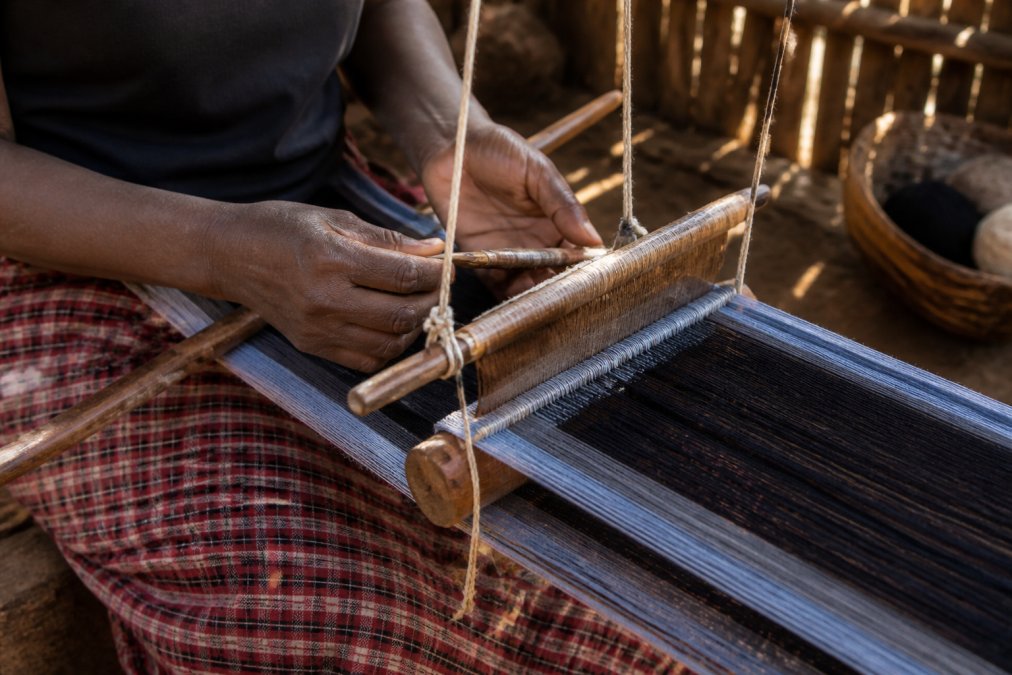
Traditional East African weaving techniques vary widely by community, but most share a common foundation: the backstrap loom. This simple device, tensioned by the weaver's own body, allows for intricate patterns that larger looms struggle to replicate.
How the Backstrap Loom Actually Works
The backstrap loom is a tension loom (si.edu). One end of the warp, the lengthwise set of threads, is tied to a fixed post, tree, or wall. The other end is tied to a strap that passes around the weaver's waist or hips. By leaning forward or back, the weaver controls warp tension in real time. That body-controlled tension is the mechanism behind the loom's flexibility: the weaver can loosen the warp to pass the weft (the crosswise thread) and tighten it to pack each row firmly against the last.
Backstrap looms are often narrow, which is why many traditions produce cloth in strips that are later sewn edge-to-edge into larger panels. A common pattern is to weave several identical strips and join them with a decorative seam, so the finished garment or blanket shows repeating bands of pattern rather than one continuous width.
Weave Structures You Can Identify by Eye
- Plain weave: The weft passes over one warp thread and under the next, alternating each row. It produces a flat, even cloth and is the base structure for most everyday cotton fabric.
- Twill: The weft floats over two or more warp threads before passing under, creating diagonal lines across the surface. Twill is denser and drapes more heavily than plain weave.
- Supplementary weft: Extra weft threads are inserted on top of the base weave to build raised motifs. This is how many geometric and figurative patterns are added without changing the underlying cloth structure.
- Ikat-style resist: Warp or weft threads are bound and dyed before weaving, so the pattern emerges from the thread itself rather than from printing. The edges of ikat motifs look slightly feathered, a reliable visual tell.
Regional Technique Differences
Weaving traditions diverge by what fiber is locally available and what the cloth is used for. In areas where sheep are kept, wool is spun and woven into heavier plain-weave and twill blankets. In communities where cotton and raffia dominate, weavers favor lighter plain weave and supplementary-weft patterning. Raffia weaving, common for mats and bags, often uses a simple over-under technique on a fixed frame rather than a body-tensioned loom, because raffia strips are stiffer and hold their shape without constant tension adjustment.
Why Hand-Woven Cloth Looks Different
Hand-woven cloth carries subtle irregularities that machine-made fabric cannot match. Slight variations in weft spacing, occasional slubs in hand-spun yarn, and minor shifts in pattern alignment are all normal. A common mistake buyers make is assuming these variations are flaws. In practice, they are signatures of the maker's hand and the strongest proof of authenticity you'll find. Machine-printed imitations of hand-woven patterns tend to show perfectly uniform spacing and crisp, identical repeats, the opposite of what a backstrap loom produces.
Tools Beyond the Loom
Weaving rarely happens on the loom alone. Most artisans also use a spindle or drop spindle for spinning fiber into yarn, a shuttle or stick for passing the weft, a beater or comb for packing rows, and a simple heddle, often made from string loops, to lift selected warp threads and create the shed the weft passes through. These tools are frequently made by the weaver or a local woodworker, which is one reason tool styles vary from one community to the next.
Natural Dyes in African Textiles
Natural dyes in African textiles come from roots, bark, leaves, and clay. Mudcloth, known as bogolanfini, is dyed with fermented mud rich in iron, producing deep browns and blacks. Indigo plants yield blues. Kola nuts and certain tree barks create warm reds and oranges.
Resist-dyeing, where wax or tied bindings block dye from reaching parts of the cloth, produces the bold patterns seen on kitenge and hand-printed fabric. This technique predates synthetic dyes by centuries and remains central to artisanal production today.
Barkcloth, Kitenge, and Khanga: Regional Material Variations
Regional material variations are one of the clearest ways to trace where a textile came from, and one of the biggest gaps in most coverage, which tends to flatten distinct traditions into a single "African fabric" category. Barkcloth, kitenge, and khanga are three different materials with three different production chains, three different fiber sources, and three different cultural roles.
Barkcloth: Beaten, Not Woven
Barkcloth is the outlier here because it is not woven at all. It is made by stripping the inner bark of certain fig-family trees, then beating the strip repeatedly with wooden mallets to spread and soften the fibers. The beating causes the fibers to interlace naturally, producing a felt-like sheet. Sheets are often beaten together edge-to-edge to make larger pieces. Prideful Pieces of Africa does not offer barkcloth products.
Because barkcloth is beaten rather than spun and woven, it has no warp, no weft, and no repeating weave structure. Its texture is soft and slightly fibrous, and it responds poorly to water, soaking causes it to stretch and lose shape. This is why barkcloth is spot-cleaned rather than washed. Historically it served as clothing and burial cloth; today it is most often used for ceremonial pieces, wall art, and decorative panels.
Kitenge: Wax-Printed Cotton
Kitenge is a wax-resist printed cotton cloth. The process works by applying wax to the fabric in a pattern, dyeing the cloth, then removing the wax so the undyed areas show through as the design. Repeated wax-and-dye cycles build up multi-colored patterns. The cloth is a medium-weight cotton, denser than khanga, and is worn as wraps, dresses, and tailored garments.
A key material point: kitenge is cotton, and the cotton itself is usually grown, ginned, spun, and woven before printing. That means the fiber quality, staple length, spinning consistency, determines how the printed cloth drapes and wears. Lower-grade short-staple cotton feels rougher and pills faster than longer-staple cotton, even when the print looks identical.
Khanga: Lighter Cloth, Built-In Message
Khanga is a lighter, looser cotton cloth, typically printed in bold borders with a central motif and a proverb or message running along one edge. The lighter weave makes it cooler to wear and quicker to dry, which is why it is common as everyday wrap cloth. The printed message is the defining feature: khanga is designed to be read, and the text is chosen by the buyer or given as a gift to communicate a specific sentiment.
How to Tell Them Apart
| Material | Fiber Source | Production Method | Weight | Water Response |
|---|---|---|---|---|
| Barkcloth | Inner tree bark (fig family) | Beaten, not woven | Medium, felt-like | Damaged by soaking |
| Kitenge | Cotton | Woven, then wax-resist printed | Medium-heavy | Washable, may bleed first wash |
| Khanga | Cotton | Woven, then printed with border text | Light | Washable, quick-drying |
Why the Distinction Matters for Buyers
Treating these as interchangeable leads to real mistakes. A buyer who washes barkcloth like kitenge will ruin it. A buyer who expects khanga to drape like kitenge will be disappointed by its lighter hand. And a buyer comparing prices across the three is comparing three different production chains, one beaten by hand, two woven and printed, so the cost differences reflect labor and fiber, not just markup.
Regional Fiber Availability Shapes the Choice
Which of these materials dominates a given community tracks local resources. Where fig-family trees are abundant, barkcloth traditions persist. Where cotton is grown and ginned locally, kitenge and khanga production clusters. Raffia, harvested from palm leaves, fills the same role in wetland and coastal areas for mats, bags, and decorative pieces.
Symbolism and Storytelling in East African Textile Patterns
Symbolism and storytelling sit at the heart of East African textile art. Patterns are rarely decorative alone. A particular motif might signal marital status, clan affiliation, or a blessing for the wearer.
Embroidery, beadwork, and symbolic designs carry indigenous knowledge forward, often taught from one generation to the next. When you wear a piece rooted in this tradition, you are wearing a story that predates you and will outlast you.
Modern Sustainability and Ethical Sourcing in East African Textile Art
Modern sustainability and ethical sourcing have become central questions for buyers who want their purchases to reflect their values. Hand-woven and hand-dyed textiles use less energy than industrial production and rely on renewable plant materials.
Supply chain transparency matters here. Ask where the fiber came from, who spun it, and whether the artisan was paid fairly. At Prideful Pieces of Africa, every piece is shaped by a single artisan, never a machine, and fair wages and transparent sourcing are built into how we work. One customer put it plainly: "Knowing my piece supports a family in Kenya makes wearing it feel sacred."
Caring for Your East African Textile Pieces
Caring for hand-woven and hand-dyed textiles protects both the fabric and the work behind it. Most cotton pieces should be hand washed or machine washed cold, then air dried away from direct sun to prevent fading.
| Material | Wash Method | Drying | Watch Out For |
|---|---|---|---|
| Cotton (kitenge, khanga) | Cold hand wash | Air dry, shade | Color bleeding on first wash |
| Barkcloth | Spot clean only | Lay flat | Water damage and stretching |
| Wool | Cold hand wash | Lay flat | Heat shrinkage |
| Raffia and bast | Wipe with damp cloth | Air dry | Prolonged moisture |
Store folded pieces away from direct light, and avoid hanging heavy textiles for long periods, which can distort the weave.
Conclusion
Choosing textile art made with real materials and real hands means accepting that no two pieces will ever match exactly. That is the point.
Prideful Pieces of Africa offers handcrafted apparel and accessories made by skilled artisans, with fair wages, transparent sourcing, and regenerative practices behind every piece. Each purchase supports a family, a child's school day, and a village's access to clean water.
Shop the collection and wear a piece of living tradition.
Frequently Asked Questions
What natural fibers are traditionally used in East African weaving?
Cotton, raffia, bast fibers (such as jute and flax), wool, and silk are the primary natural fibers. Cotton dominates in hand-woven kitenge and khanga, while raffia comes from the raffia palm and is common in Uganda and Tanzania. Barkcloth is made from the inner bark of the mutuba tree. These fibers are often spun by hand and dyed with plant-based pigments before weaving.
How do raw materials influence the durability of East African textiles?
Durability depends on fiber length, strength, and how the fabric is finished. Long-staple cotton and tightly twisted bast fibers produce stronger yarns that resist wear. Hand-loomed fabrics often have slight irregularities that add character but may require gentler care. Proper washing and storage, such as hand washing in cold water and drying in shade, extend the life of these textiles significantly.
What role do natural dyes play in traditional East African fabric art?
Natural dyes from plants, insects, and minerals give East African textiles their distinctive earthy and vibrant tones. Indigo, turmeric, and various tree barks are common. These dyes are often applied through resist-dyeing techniques like tie-dye or batik. Beyond color, natural dyes carry cultural meaning and are favored for their lower environmental impact compared to many synthetic alternatives.
Are synthetic materials commonly integrated into modern East African apparel?
Yes, polyester and other synthetics are increasingly used in modern East African apparel, especially for printed wax fabrics that need to hold bright colors and resist wrinkles. However, many artisans and ethical brands continue to prioritize natural fibers like cotton and silk. When shopping, check product descriptions: authentic handcrafted pieces often specify natural fiber content and traditional dye methods.